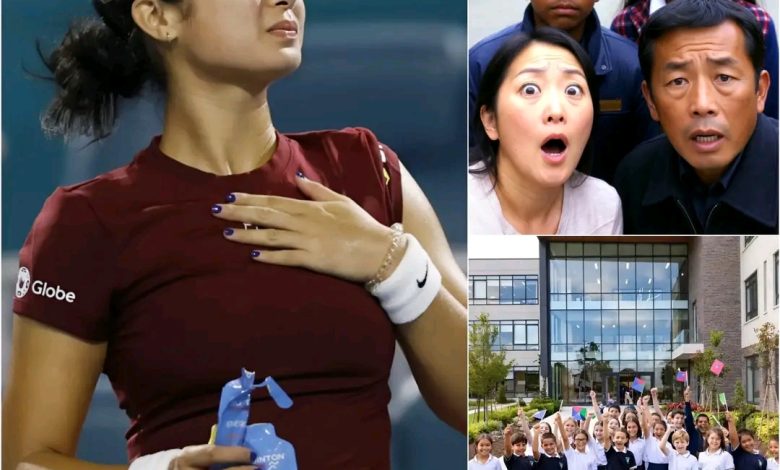
❤️GOOD NEWS: Alexandra Eala the most famous and successful tennis player in the Philippines donated 200 million Pesos to celebrate her 20th birthday to build a school in Metro Manila for 20,220 students from the poorest regions of all over the world, causing a stir. Parents broke down in tears upon hearing this, thousands of applications were submitted. But what was more surprising was when Alexandra Eala stood up on the podium and revealed the secret behind this, leaving everyone speechless!…

Metro Manila was buzzing with excitement on what seemed like any ordinary day, but on the morning of Alexandra Eala’s 20th birthday, the city witnessed something extraordinary.
The Filipino tennis sensation, widely regarded as the country’s most famous and successful young athlete, had planned a surprise that would not only mark a milestone in her life but also make history in the world of philanthropy.
Alexandra, known for her dedication on the tennis court and her humble demeanor off it, had just announced a donation of 200 million Pesos to build a school in the heart of Metro Manila for 20,220 students from the poorest regions across the globe.
The news spread like wildfire. Social media platforms exploded with excitement, admiration, and disbelief.
How could a 20-year-old athlete, no matter how successful, envision a project of such magnitude? Parents across the Philippines and even from neighboring countries began contacting the organizers, many breaking down in tears, overwhelmed by the promise that their children could finally access a world-class education.
Within hours, thousands of applicationsflooded in, all hoping for a chance to send their children to a school that promised not only classrooms and textbooks but a future filled with opportunity.
The school, as Alexandra explained in a brief press release, would not be a typical educational institution. It would be a center of innovation, creativity, and empowerment. Classrooms would be equipped with the latest technology, science laboratories, arts studios, and sports facilities.
Teachers would undergo rigorous training to ensure students received holistic education. Each student would also have access to mentorship programs, scholarships for international study, and programs that encourage entrepreneurship.
Alexandra’s vision was clear: to give children from the most disadvantaged communities a fighting chance in a world where opportunity is often dictated by circumstances of birth.
However, the initial reactions were not universally positive. Some questioned the feasibility of the project. “Can a young athlete really manage a school of 20,220 students?” skeptics asked. Others raised concerns about transparency, sustainability, and logistics.
Could the initiative be more than a publicity stunt? Alexandra, who had faced public scrutiny for her career decisions in the past, remained calm. She knew that the true impact of her project would speak louder than any skepticism or online debate.
The real spectacle, however, occurred during the official ceremony held in a specially constructed pavilion in central Manila. Alexandra, dressed elegantly yet simply, walked onto the podium amidst a crowd of journalists, dignitaries, parents, and students who had been invited as part of a preview program. The atmosphere was electric.
Children’s eyes widened in anticipation, and parents clutched one another’s hands, some dabbing tears from their cheeks. The air was filled with a mixture of hope, awe, and sheer curiosity.
Alexandra began speaking, her voice steady but brimming with emotion. “When I was a child, I dreamed not only of winning tennis tournaments but also of creating opportunities for others,” she said.
“I have been fortunate to travel the world, compete against the best, and learn from experiences that many children in our country and beyond cannot even imagine. Today, on my 20th birthday, I want to share that fortune.
I want to give a chance to 20,220 young minds to dream, to learn, and to rise above their circumstances.”
The crowd erupted in applause, but Alexandra raised her hand for silence. She then leaned closer to the microphone and smiled. “But there’s something you don’t know,” she said. The whispering began, as reporters frantically typed and cameras zoomed in. “This school, and every Pesos donated, is only the beginning.
Because I didn’t do this alone.”
A hush fell over the audience. People were on the edge of their seats, waiting. Alexandra continued: “Behind this initiative is a partnership with educators, technologists, philanthropists, and even my fellow athletes. Together, we’ve created a model school that can be replicated in other countries.
Every student you see today will not only have access to education, but will also become part of a global network of mentorship, internships, and cultural exchange. The secret is not just the money—it’s the system we are building. A system that empowers children to change their own world.”
Parents and spectators were speechless. Some wept openly, overwhelmed by the magnitude of the announcement. The journalists scrambled to capture every word, realizing that Alexandra’s secret was not a gimmick, but a revelation of a well-thought-out, sustainable, and potentially world-changing plan.
Social media erupted again, this time with hashtags like #AlexandraEalaSchool, #20KDreams, and #PhilippineTennisHero trending globally within minutes. Videos of Alexandra speaking, interspersed with footage of children clapping and smiling, were shared millions of times.
International news outlets picked up the story, highlighting not only her athletic achievements but also her dedication to social impact. Analysts praised her foresight and noted that such initiatives could serve as models for athletes worldwide who wish to use their influence and resources for meaningful change.
By the end of the ceremony, the true scope of Alexandra’s plan was revealed: the school would include classrooms designed by architects specializing in disaster-resistant structures, green energy sources to minimize environmental impact, and programs to teach students coding, science, arts, and sports.
Scholarships would be awarded not only to local children but also to students from other countries in Asia, Africa, and Latin America, making it one of the most ambitious educational projects ever spearheaded by a young athlete.
In the following days, stories poured in from parents who received acceptance letters for their children. Many described moments of tears and disbelief, recalling how their lives had been touched by a single act of generosity.
Meanwhile, Alexandra continued her tennis training, balancing her preparation for upcoming tournaments with the oversight of her philanthropic project—a testament to her commitment both on and off the court.
Alexandra Eala’s 20th birthday will not be remembered just for the celebration or the gifts she received, but for a gesture that embodies vision, compassion, and leadership.
In a world often dominated by headlines of scandal or self-interest, a young tennis player from the Philippines reminded everyone that greatness is measured not only by trophies won but by lives transformed.
By combining her fame, fortune, and foresight, Alexandra has turned her birthday into a historic day for education, philanthropy, and hope. And the secret she revealed—a network, a system, a sustainable plan—ensures that her gift will resonate for generations.
Today, Metro Manila is not just a city; it is a beacon of possibility, all thanks to a 20-year-old athlete whose vision reached far beyond the tennis court. The world now watches eagerly, asking: what will Alexandra Eala inspire next?