

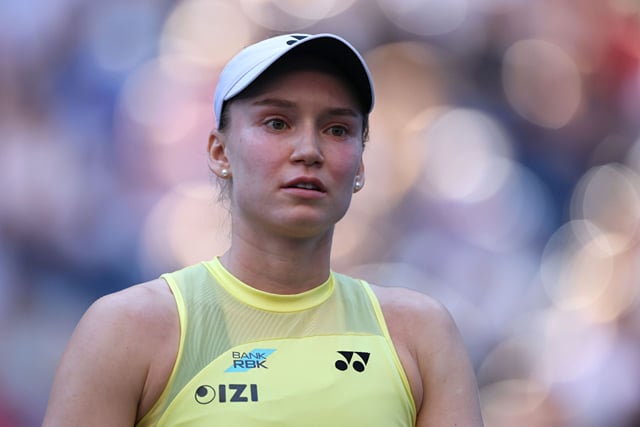
Elena Rybakina faces a brutal WTA Finals draw as she targets historic title defence
Elena Rybakina arrives at the WTA Finals as the defending champion, world No. 1 and a player who has already secured the year-end top spot, but the draw has not made her title defence straightforward. She is in Group 1 alongside Coco Gauff, Jessica Pegula and Linda Noskova, a quartet that includes three of this year’s four Grand Slam champions: Rybakina won the Australian Open and US Open, while Noskova claimed Wimbledon.
Rybakina opens her campaign against Noskova on Sunday, November 8, in the tournament’s first match in Indian Wells. The bigger question is whether the group can prevent her from becoming the first player to defend the WTA Finals title since Serena Williams completed a hat-trick of victories between 2012 and 2014. Only two of the four players will advance to the semifinals on November 14.
On paper, Rybakina is the favourite to progress, and her credentials go well beyond her world No. 1 ranking. She has been one of the standout players of the season, won two Grand Slam titles and secured the year-end top spot before arriving in California. The numbers also show that she has not lost to any of her three group opponents in 2026. The threat is real, but it comes from the round-robin format and potentially her own physical condition as much as from the names across the net.
The group on paper
Group 1 looks like the tougher of the two on paper. Group 2 features Aryna Sabalenka, Mirra Andreeva, Elina Svitolina and Karolina Muchova, and some previews have described it as the more evenly matched section. However, Rybakina’s group brings together the defending champion, the 2024 winner, a former finalist and the reigning Wimbledon champion.
All four players have enjoyed significant success this season, with Rybakina’s two Grand Slam titles, Gauff’s Cincinnati crown, Pegula’s victories in Dubai and Charleston, and Noskova’s Wimbledon and Berlin titles.
| Seed | Player | 2026 record | Titles | WTA Finals credentials |
| 1 | Elena Rybakina | 53-14 | 4 | Champion 2025 |
| 4 | Coco Gauff | 47-15 | 1 | Champion 2024 |
| 5 | Jessica Pegula | 50-14 | 2 | Runner-up 2023 |
| 8 | Linda Noskova | 35-15 | 2 | Debut |
Gauff and Pegula also bring considerable WTA Finals experience. Pegula reached the championship match in 2023, where she lost to Iga Swiatek, while Gauff won the title a year later after defeating Zheng Qinwen in a dramatic three-set final. Both Americans will also benefit from playing in California, giving them the advantage of familiar surroundings and potentially strong home support when the margins are narrow.
Noskova, meanwhile, makes her WTA Finals debut with credentials of her own, although she has considerably less experience at this level than the other three players. On paper, she may be considered the outsider, but the Czech has the weapons to trouble virtually any opponent.
Her serve can match the biggest hitters on tour, including Rybakina and Sabalenka, while her composure has already been tested on some of the sport’s biggest stages. It would be surprising if Noskova left the round-robin stage without at least one victory.
What the head-to-heads say
Rybakina’s record against her group opponents provides another reason to consider her the favourite. She defeated Gauff twice and Pegula three times during the 2026 season, while she has yet to face Noskova this year. However, their previous meetings have all gone the Kazakh’s way in straight sets.
None of Rybakina’s 14 defeats in 2026 has come against a player in her group. That gives the defending champion a significant statistical advantage heading into the round robin, although the WTA Finals format leaves little room for mistakes. One unexpected defeat can quickly complicate qualification, particularly when two of the four players are eliminated.
| 2026 match | Rybakina | Score |
| Australian Open semifinal | Beat Pegula | 6-3, 7-6(7) |
| Indian Wells quarterfinal | Beat Pegula | 6-1, 7-6(4) |
| Miami quarterfinal | Beat Pegula | 2-6, 6-3, 6-4 |
| Canadian Open semifinal | Beat Gauff | 5-7, 6-2, 6-2 |
| US Open semifinal | Beat Gauff | 3-6, 6-4, 6-4 |
The table also shows where the risk is. All five of Rybakina’s wins over Gauff and Pegula were close. She lost the first set against Gauff in both semifinals and against Pegula in Miami, and her other two wins over Pegula both needed a second-set tiebreak. A player who has to come back from a set down three times is not controlling the match-up, and in a round robin there is little room to start slowly.
Gauff, Pegula and Noskova: who is the real threat?
Gauff is the most dangerous opponent on paper. She is the 2024 WTA Finals champion and reached the semifinals at both Wimbledon and the US Open, where she lost to Rybakina in New York. She also won both of her meetings with Pegula in 2026, although their overall head-to-head record is tied at 5-5. The two Americans will face each other on Sunday, immediately after Rybakina’s opening match.
Pegula has enjoyed the most consistent season of the three, recording 50 wins, claiming two titles and reaching three other finals in Berlin, Washington and Cincinnati.
Her problem against Rybakina has been the same throughout the year: she has struggled to close out their closely contested encounters. They also met at Indian Wells earlier this season, where Rybakina won in straight sets, suggesting that the California conditions could once again favour the world No. 1.
Noskova is the ‘wildcard’ in the group. She makes her WTA Finals debut as the reigning Wimbledon champion and became the youngest women’s singles champion at the All England Club since Petra Kvitova in 2011.
Her 35-15 record is the weakest among the eight qualifiers, and she secured her place through the Grand Slam champion qualification rule rather than the regular ranking criteria. She has also lost all three previous meetings with Rybakina without taking a set. However, Noskova will have nothing to lose when she opens her campaign against the defending champion.
The real risk is not the draw
The history of the WTA Finals suggests that defending the title is one of the toughest challenges in the sport. Iga Swiatek, the 2023 champion, failed to advance from her group in 2024, while Coco Gauff followed the same path in 2025, finishing the round robin with a 1-2 record. No player has successfully defended the singles title since Serena Williams won three consecutive editions between 2012 and 2014.
Since Williams completed that hat-trick, every edition has produced a different champion. The defending champion’s situation has varied over the years, with some failing to qualify, others missing the tournament and the last two being eliminated in the group stage.
| Year | Previous champion | What happened to the defending champion |
| 2021 | Ashleigh Barty | Did not participate |
| 2022 | Garbiñe Muguruza | Failed to qualify |
| 2023 | Caroline Garcia | Failed to qualify |
| 2024 | Iga Swiatek | Eliminated in the Round Robin |
| 2025 | Coco Gauff | Eliminated in the Round Robin |
| 2026 | Elena Rybakina |
Group 1 is undoubtedly challenging, but it is not a draw in which Rybakina should be considered the underdog. She has a winning record against all three opponents, including five victories over Gauff and Pegula combined in 2026, and has already beaten Noskova three times without dropping a set.
Her two Grand Slam titles and year-end No. 1 ranking further strengthen her position. The most likely scenario is that she advances to the semifinals, where the historical pattern of the past decade could become more relevant.
However, the WTA Finals have repeatedly produced unexpected results. Rybakina’s own experience from last year is a good example. She was the final player to qualify for the tournament, securing her place only after reaching the semifinals in Tokyo. Her late surge came at Mirra Andreeva’s expense, with the Russian missing out on qualification and becoming the first alternate. Rybakina then went on to produce an outstanding run in Riyadh, winning all five matches and dropping just one set to claim the biggest title of her career.
On paper, Rybakina should be the favourite to finish at the top of Group 1, and it would be a surprise if she failed to reach the semifinals. In reality, however, the circumstances could create an opportunity for an upset.
Having already secured the year-end No. 1 ranking, she arrives in Indian Wells without the pressure of fighting for the top spot. That could work in her favour, allowing her to play freely, but it could also become a double-edged sword for a player who has already achieved the biggest objective of her season.
The numbers that should concern Rybakina are therefore not simply her opponents’ rankings. They include the occasions when she has surrendered the opening set against Gauff and Pegula, the history of defending champions struggling in this format and the physical problems that have affected her since the summer. If she is healthy, Group 1 is a difficult obstacle. If she is not, it could become a trap.