
Jelena Ostapenko Refuses to Shake Hands With Rival After WTA Finals Defeat
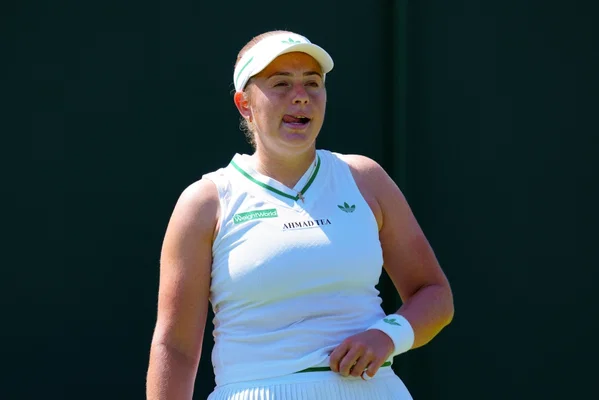
The traditional handshake at the net is one of tennis’s simplest displays of sportsmanship, but not at the 2026 WTA Finals in Indian Wells, where Jelena Ostapenko was involved in another uncomfortable exchange that quickly became a talking point. A heated doubles contest against Gabriela Dabrowski and Luisa Stefani took an unexpected turn after one particular exchange near the net.
Ostapenko and her partner Hsieh Su-wei lost 2-6, 7-6(2), 10-3 to Gabriela Dabrowski and Luisa Stefani in their final Group 1 match on Friday. The result sent the Canadian-Brazilian pairing into the semifinals with a perfect group-stage record. However, the result was not the only thing that caught attention.
The tension appeared to build during the match itself. Dabrowski struck several shots towards Ostapenko during aggressive exchanges, and the Latvian seemingly felt that some of them came uncomfortably close. An icy stare between the two players was noticed earlier in the contest, and the disagreement appeared to carry over after the final point.
Ostapenko did not offer Dabrowski the customary handshake at the net. The Canadian, meanwhile, had little reason to celebrate a comfortable finish to the match, as her team had needed a significant turnaround to get there.
There is no confirmed evidence that Dabrowski deliberately targeted Ostapenko or intended to provoke her. Reports ScoreGO described the shots as part of a physical contest, with Ostapenko apparently taking issue with their proximity. The exact words exchanged between the players, if any, have not been established.
The match itself had several momentum swings. Ostapenko and Hsieh controlled the opening set, breaking their opponents repeatedly to take it 6-2 in just 32 minutes. They carried that momentum into the second set and moved ahead 3-1.
Dabrowski and Stefani then found their rhythm. They recovered the break, forced a tiebreak, and won it 7-2. The deciding match tiebreak was far more one-sided. The top seeds won it 10-3, completing their comeback and securing their third group-stage victory. It was their 56th win of the season, and they had now won 19 of their previous 20 matches.
The defeat ended Ostapenko and Hsieh’s group campaign with a 1-2 record. They finished third in Group 1 and failed to qualify for the semifinals. Dabrowski and Stefani, meanwhile, advanced to face Katerina Siniakova and Taylor Townsend in the last four.
This was not the first time Ostapenko had been involved in an uncomfortable post-match exchange. At the 2025 US Open, she confronted Taylor Townsend after losing their second-round singles match. Ostapenko accused the American of showing a lack of class and education because Townsend had not apologized after winning a point through a net cord. She later apologized for her choice of words.
Another notable incident occurred at the 2024 Qatar Open, when Ostapenko lost to Victoria Azarenka 6-0, 6-3. Instead of offering her hand, the Latvian raised her racket towards Azarenka. The Belarusian did not reciprocate the gesture and instead shook hands with the chair umpire. The incident attracted considerable attention because it followed a series of defeats for Ostapenko against Azarenka.
There was also a reversal of sorts at Wimbledon in 2026. After Ostapenko and Marcelo Arevalo defeated Laura Siegemund and Edouard Roger-Vasselin in mixed doubles, Siegemund refused to shake Ostapenko’s hand following an argument over a time violation. The disagreement continued near the umpire’s chair.
These incidents do not establish a personal feud between Ostapenko and Dabrowski. However, they provide context for why another tense exchange involving the Latvian attracted attention.
Elina Svitolina Also Refuses to Shake Hands With Aryna Sabalenka
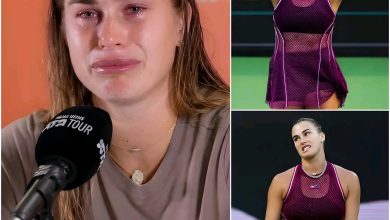
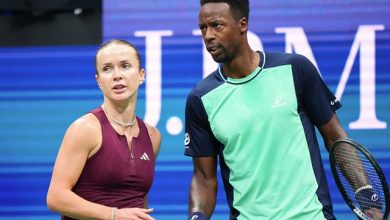
Ostapenko’s incident was not the only post-match handshake story at the WTA Finals on Friday. Elina Svitolina also skipped the customary exchange after defeating Aryna Sabalenka 6-3, 3-6, 6-1 in their singles encounter.
Unlike Ostapenko’s disagreement with Dabrowski, Svitolina’s decision was not a reaction to something that happened during the match. The Ukrainian has consistently refused to shake hands with Russian and Belarusian players since Russia’s full-scale invasion of Ukraine in 2022. Sabalenka, who represents Belarus, is therefore among the players affected by that stance.
The result was significant for Svitolina, who reached the semifinals for the first time since 2019. She also ended a run of five consecutive defeats against Sabalenka, earning her first victory over the Belarusian in more than six years. Svitolina moved on to face Linda Noskova in the semifinals, while Sabalenka’s tournament ended.
The two incidents offered very different explanations for the missing handshakes. Svitolina’s decision reflected a longstanding political position, whereas Ostapenko’s appeared to stem from frustration during a competitive doubles match. Both, however, ensured that the WTA Finals had plenty to discuss beyond the results on court.