
Just In: Does Emma Still Fall Behind? The 10 Highest-Paid British Female Tennis Players Revealed, Along With Their Defining Matches
Emma Raducanu is closing in on another significant milestone in her young career. The supplied earnings snapshot places her on $5,957,378, only $24,996 behind Heather Watson. Johanna Konta remains Britain’s leading woman with more than $10 million in official prize money. The figures suggest Raducanu could soon rise to second place, although becoming the highest paid tennis player in British women’s tennis will require further success at major tournaments.
This overview of ten of Britain’s highest-earning female tennis players was prepared with insights from the team Ice Casino, combining career prize money with the achievements that defined each player’s journey. As active competitors progress through the season, both their earnings and positions may change.
How Career Prize Money Is Calculated
Professional tennis does not provide a guaranteed annual salary. Players earn prize money according to the tournaments they enter and the rounds they reach. Those gross payments do not reveal how much an athlete ultimately keeps.
This comparison follows four principles:
- Career prize money is shown in US dollars where reliable figures are available.
- Sponsorships, investments and private commercial agreements are excluded.
- Career-high rankings provide sporting context but do not determine financial position.
- Active and retired professional tennis players are identified separately.
The distinction matters when comparing women tennis players from different generations. Tournament purses have increased substantially, meaning today’s competitors can earn more from fewer victories.
The following table explains the three financial terms most frequently confused in tennis coverage.
| Financial measure | What it means | Included here? |
| Career prize money | Gross tournament payments earned during a career | Yes |
| Sponsorship income | Payments from brands and commercial partners | No |
| Net worth | Estimated assets after income, expenses and liabilities | No |
British Female Tennis Stars with Notable Career Earnings
Money provides one way to compare careers, but it cannot measure every achievement. These female tennis stars competed in different eras and faced very different financial conditions.
Emma Raducanu
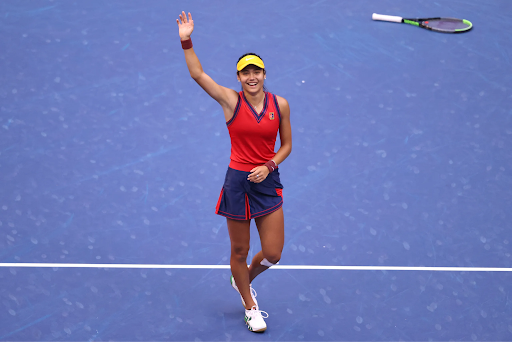
Emma Raducanu was born in Toronto in 2002 to a Romanian father and Chinese mother. Her family moved to England when she was two, and she grew up in Bromley. She turned professional in 2018 while continuing to balance competition with her education. Raducanu became a famous tennis player after reaching Wimbledon’s fourth round on her 2021 Grand Slam debut. Months later, she won ten consecutive matches to capture the US Open as a qualifier. She did not drop a set and defeated Leylah Fernandez in the final. The title paid $2.5 million, while her supplied career prize money now stands at $5,957,378. Injuries have interrupted later seasons, but her age leaves considerable time to challenge Konta’s record.
Johanna Konta
Johanna Konta was born in Sydney in 1991 and moved to Britain during her development. She began representing Great Britain in 2012 and later established herself among the top female tennis players. Her powerful serve and aggressive baseline game carried her to world No. 4 in 2017. Konta reached Grand Slam semi-finals at the Australian Open, Wimbledon and French Open. She won four WTA singles titles, including the prestigious Miami Open in 2017. That victory produced $1,175,505 during a season in which she earned almost $3 million. Her official career prize money reached $10,008,175 before her retirement in 2021. Konta remains the leading British woman in the supplied earnings comparison.
Heather Watson
Heather Watson was born in Guernsey in 1992 and developed at the Nick Bollettieri Tennis Academy. She announced her potential by winning the US Open junior title in 2009. Watson later reached world No. 38 and secured four WTA singles trophies. Her longevity distinguishes her among the tennis players female British supporters have followed across several generations. She also won the 2016 Wimbledon mixed doubles title alongside Finland’s Henri Kontinen. Watson reached the Wimbledon singles fourth round in 2022, her best result at a major. The supplied snapshot gives her career prize money as $5,982,374. That total leaves her only narrowly ahead of Raducanu in second place among the listed British earners.
Katie Boulter
Katie Boulter was born in Leicester in 1996 and started playing tennis during childhood. Her development included injury setbacks, but she eventually established herself inside the WTA top 100. Boulter won her first tour-level singles title on grass at Nottingham in 2023. She retained that trophy in 2024 by defeating Karolína Plíšková in the final. Her largest title came at the 2024 San Diego Open, a WTA 500 event. Those performances helped her reach a career-high singles ranking of No. 23. Boulter’s supplied career prize money is $3,953,394, including $950,039 earned during 2025. She remains one of the most recognisable British tennis stars competing on the international tour.
Harriet Dart
Harriet Dart was born in London in 1996 and began playing at the age of seven. She progressed through ITF tournaments before establishing herself regularly at tour-level events. Dart reached a career-high singles position of No. 70 in 2022. That season included an impressive run to the fourth round at Indian Wells. She has also reached Wimbledon’s third round twice and contested several WTA doubles finals. Dart was runner-up with Joe Salisbury in the 2021 Wimbledon mixed doubles competition. Her supplied career earnings stand at $3,202,971 despite having no WTA singles title at that snapshot. Consistent appearances at Grand Slams have made her one of Britain’s familiar female competitors.
Anne Keothavong
Anne Keothavong was born in Hackney in 1983 to parents who had left Laos. She became British national champion eight times and developed mainly through lower-tier international tournaments. Keothavong reached world No. 48 in 2009 after producing several strong tour-level results. She was the first British woman in 16 years to enter the singles top 50. Her playing career produced 20 ITF singles titles and eight ITF doubles trophies. Reported career prize money was approximately $1.3 million. She retired in 2013 after representing Britain extensively in international team competition. Anne Keothavong subsequently became a broadcaster and captain of Britain’s Billie Jean King Cup team.
Elena Baltacha
Elena Baltacha was born in Kyiv in 1983 and moved to Britain with her family. She grew up in Scotland and later represented Great Britain throughout her professional career. Baltacha overcame serious health and injury problems to reach world No. 49 in 2010. She spent several periods as British No. 1 during a challenging era for the national game. Her achievements included 11 ITF singles titles and victories over several highly ranked opponents. Reported career prize money was approximately $1.2 million. Her resilience made her one of the top women tennis players in Britain during the 2000s. Baltacha retired in 2013 and died from liver cancer the following year, aged 30.
Jodie Burrage
Jodie Burrage was born in Kingston upon Thames in 1999 and trained at the National Tennis Centre. Her junior progress was repeatedly interrupted by ankle operations and other physical setbacks. Burrage nevertheless entered the WTA top 100 for the first time during 2023. She reached her maiden tour final at Nottingham, losing an all-British contest against Boulter. Later that year, she recorded her first main-draw victory at the US Open. Burrage has also represented Great Britain in the Billie Jean King Cup. Her career prize money has been reported above $1.5 million. Continued fitness could allow her to improve both her ranking and earnings significantly.
Katie Swan
Katie Swan was born in Bristol in 1999 and spent part of her childhood in the United States. She attracted international attention by reaching the 2015 Australian Open girls’ singles final. Swan also became one of Britain’s youngest Billie Jean King Cup representatives. Her senior career has included several ITF titles and qualifying appearances at major tournaments. In 2022, she reached a career-high singles ranking of No. 118. Injuries have repeatedly halted her momentum and reduced access to higher-paying tour events. Her reported career prize money exceeds $800,000. Swan’s record illustrates how health and scheduling affect the finances of developing players.
Francesca Jones
Francesca Jones was born in Bradford in 2000 and started playing tennis as a young child. She was born with ectrodactyly ectodermal dysplasia, which affects her hands and feet. Medical specialists initially questioned whether a professional sporting career would be physically possible. Jones nevertheless developed in Barcelona and qualified for the 2021 Australian Open. That achievement brought her first appearance in the main draw of a Grand Slam tournament. She has since produced encouraging results on clay while managing recurring injury interruptions. Her reported earnings are approaching $1 million. Francesca Jones remains an example of persistence rather than a story defined solely by her condition.
Five Defining Matches Involving British Women
These matches were selected for their sporting importance and lasting public recognition. Each involved a major title, a landmark breakthrough or an outstanding performance against an elite opponent.
- Raducanu vs Leylah Fernandez, 2021 US Open final. Raducanu defeated the Canadian 6–4, 6–3 to become the first qualifier to win a Grand Slam singles title. She completed the tournament without losing a set.
- Konta vs Simona Halep, 2017 Wimbledon quarter-final. Konta recovered from a set down to win 6–7, 7–6, 6–4. The result made her Britain’s first Wimbledon women’s semi-finalist since Virginia Wade in 1978.
- Konta vs Caroline Wozniacki, 2017 Miami Open final. Konta defeated the former world No. 1 by 6–4, 6–3. It was the largest title of her career and helped propel her towards the top five.
- Watson vs Serena Williams, 2015 Wimbledon third round. Watson pushed the eventual champion deep into a deciding set before losing 6–2, 4–6, 7–5. She had served for the match and came within two points of a famous upset.
- Boulter vs Karolína Plíšková, 2022 Wimbledon second round. Boulter recovered to defeat the previous year’s finalist 3–6, 7–6, 6–4. The emotional Centre Court victory represented one of her biggest early breakthroughs.
How Britain Helped Transform Tennis into a Global Sport
Britain played a central role in turning tennis from a recreational pastime into an organised international sport. The country established rules, competitions and traditions that still shape the professional game. Its influence is most visible at Wimbledon, but it also extends to equipment, court surfaces and tournament culture.
From Victorian Lawns to the First Wimbledon Championship
Modern lawn tennis emerged during the 1870s, drawing inspiration from older European racket games. Major Walter Clopton Wingfield helped popularise an early version by selling equipment sets and publishing rules in 1874. The game initially used an hourglass-shaped court before the rectangular format became standard.
The All England Club staged the first Wimbledon Championship in 1877. Only the gentlemen’s singles event was contested, and Spencer Gore defeated William Marshall in the final. The women’s singles competition followed in 1884, when Maud Watson became its inaugural champion. Wimbledon eventually developed into one of the four Grand Slam tournaments alongside the Australian Open, French Open and US Open.
Several traditions from its early history remain visible today. Players must wear predominantly white clothing, matches are contested on grass, and royal patronage remains part of the tournament’s identity. These customs distinguish Wimbledon from other major events, even as retractable roofs and advanced officiating technology have modernised the competition.
The Rise of Prize Money in Professional Tennis
For much of tennis history, leading events were reserved for amateurs. This changed with the beginning of the Open Era in 1968, when professionals were permitted to compete alongside amateurs at major championships. The reform created a more commercially sustainable sport and allowed leading players to build careers from tournament earnings.
Women’s tennis experienced another important change when the US Open introduced equal prize money in 1973. Wimbledon became the last Grand Slam to adopt equal payments for its men’s and women’s champions in 2007. These developments helped successful female players earn sums that earlier generations could not realistically achieve.
Johanna Konta is a clear British example of this financial growth. Her career prize money reached $10,008,175, supported by four WTA titles and Grand Slam semi-finals at the Australian Open, French Open and Wimbledon. Her success made Johanna Konta the richest tennis player among the British women featured here, with career prize money exceeding $10 million.
How Tennis Players Became Fashion and Cultural Figures
Professional tennis offers athletes an unusual level of individual visibility. Players compete without helmets, represent themselves rather than a domestic club, and regularly appear in close-up television coverage. Their clothing, personality and behaviour therefore become closely associated with their public identity.
From Functional Clothing to Global Fashion Campaigns
Tennis fashion has changed dramatically since the restrictive dresses worn during the Victorian period. Suzanne Lenglen challenged convention during the 1920s with shorter skirts, sleeveless outfits and colourful headbands. Decades later, players such as Billie Jean King, Chris Evert and Serena Williams used clothing to express confidence while competing at the highest level.
Modern athletes often work with fashion houses, jewellery companies and luxury brands. Emma Raducanu became an ambassador for Dior and Tiffany & Co. after her 2021 US Open victory, while Maria Sharapova built a global commercial profile alongside her five Grand Slam titles. Anna Kournikova, Ana Ivanovic and Serena Williams also became familiar figures in advertising, magazines and popular culture.
Katie Boulter has attracted similar attention in Britain through her fashion appearances and public profile. However, her reputation is also supported by measurable sporting achievements, including titles in Nottingham and San Diego and a career-high position inside the world’s top 25. Fashion exposure can expand an athlete’s audience, but sustained public interest usually depends on credible performances.
Why Appearance Attracts Attention in Tennis
Tennis players are frequently presented as symbols of health, confidence and athleticism. This helps explain online interest in hot tennis players, with names such as Raducanu, Boulter, Sharapova, Ivanovic and Kournikova often appearing in lifestyle coverage. Such descriptions are subjective, however, and reveal more about celebrity culture than sporting quality.
Raducanu’s international appeal, for example, combines her personal style, multicultural background and historic achievement in New York. She became the first qualifier to win a Grand Slam singles title, completing ten matches without losing a set. That accomplishment provides the foundation for her public profile, while commercial campaigns broaden her recognition beyond tennis.
The same distinction applies to other prominent athletes. Ivanovic won the 2008 French Open, Sharapova completed a career Grand Slam, and Serena Williams captured 23 major singles titles during the Open Era. Boulter became British No. 1 and won increasingly valuable tour events after overcoming serious injury interruptions. Their appearance may generate lifestyle coverage, but their competitive records explain why they remain significant sporting figures.