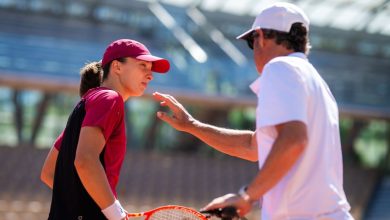
“I WILL SUE YOU TO THE MAXIMUM EXTENT” Iga Swiatek has filed a lawsuit against Alexandra Eala, claiming she was offended by the words after the most shocking moment of the season, Alexandra Eala defeated world No. 1 Iga Swiatek in the quarterfinals of the Miami Open. However, contrary to expectations, Eala immediately exposed the story of Iga Swiatek refusing to have her racket tested when it was suspected that her racket had an elastic motor that was not approved by the WADA Anti-Corruption Association, raising doubts. The official verdict regarding Iga Swiatek shocked everyone, including the judge…

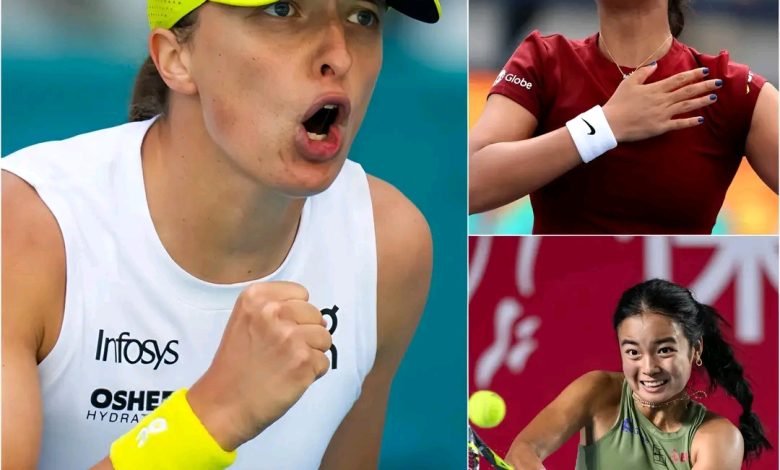
I WILL SUE YOU TO THE MAXIMUM EXTENT.” Those were the exact words shouted by World No. 1 Iga Świątek as she stormed out of a private legal hearing on Tuesday morning, escalating what has rapidly become the most astonishing controversy of the 2025 tennis season.
The entire drama erupted only days after Alexandra Eala shocked the world by defeating Świątek in the quarterfinals of the Miami Open, a match that had already been labeled a generational upset even before the off-court chaos began.
What nobody expected was that the match would become only the first chapter of a much larger and far more explosive story.
The controversy started innocently enough during Eala’s post-match press conference. Reporters were eager to understand how the 19-year-old Filipino star had managed to crack Świątek’s consistency, movement, and mental toughness, qualities that had defined the Polish champion’s dominance for the past three years.
But instead of focusing solely on strategy or emotions, one journalist asked about a brief on-court disagreement between Eala and tournament officials following a changeover.
Eala hesitated for a moment, as if weighing whether she should reveal what she knew, and then delivered the sentence that ricocheted across the sports world.
“She refused to have her racket tested,” Eala said calmly, “even though they suspected it had an unapproved elastic motor that the WADA Anti-Corruption Association flagged earlier this week.” For a split second the room was silent, frozen in uncertainty, and then erupted into chaos. Reporters gasped. Cameras clicked furiously.
Social media exploded within seconds. And Świątek’s camp, watching the press conference from the players’ lounge, reportedly erupted in disbelief and fury.
The term “elastic motor” seemed so bizarre, so mechanical, so unprecedented, that many assumed Eala had misspoken. Others believed she had just exposed the biggest scandal since the creation of the modern racket-testing system.
Within an hour, three major sports networks ran emergency news segments discussing whether such a device could physically exist. Equipment experts argued live on television. Bloggers circulated conspiracy theories. Fans demanded answers.
The Miami Open management team was forced to confirm that the WADA Anti-Corruption Association had, indeed, requested a voluntary inspection of Świątek’s racket after “irregular vibration data” was detected during routine monitoring.
The data itself did not prove wrongdoing. It did not even imply intent. But it did raise questions, and those questions became fuel for a firestorm once Świątek declined the voluntary test.
According to her team, the refusal was based on timing, privacy, and a belief that the request was baseless. According to Eala, it was every athlete’s duty to comply when the integrity of the sport was on the line.
Whatever the truth, Eala’s decision to speak publicly was enough to ignite an international crisis.
By the following morning, Świątek had already filed a lawsuit in both Florida and Poland, accusing Eala of defamation, reputational sabotage, and malicious fabrication.
Her attorney condemned the statement as “a reckless, harmful, and entirely false accusation that threatens to undermine the credibility of a clean and respected athlete.” Świątek herself released a brief video message in which she appeared visibly distressed.
“I will sue you to the maximum extent,” she said in a sharp, trembling voice that left little doubt about her emotional state. “I will not allow lies to destroy what I have built.”
The legal hearing that followed was supposed to be a procedural formality. Instead, it became a spectacle that stunned everyone present, including the presiding judge. As part of the court’s evidence review, officials were required to present the confidential technical report that Eala had referenced.
The document did not accuse Świątek of cheating. It did not confirm the existence of any prohibited device.
But it did list several anomalies: unexpected shock-wave patterns, micro-vibrations beyond the typical range of carbon-fiber rackets, and what investigators described as “a non-standard internal echo signature.” To a layperson, these terms meant little. To the tennis world, they meant possible manipulation.
Observers inside the courtroom reported that the judge paused while reading the report, leaned back, and stared over her glasses in visible disbelief. The silence was heavy, broken only when one of Świątek’s attorneys insisted that the irregularities were caused by natural wear and tear.
Eala’s team countered that if it was truly normal, Świątek would not have refused inspection. The argument escalated rapidly, and the judge was forced to call for order multiple times.
What made the situation even more dramatic was the testimony of a Miami Open technician, who stated under oath that the elastic-motor suspicion came not from a human complaint but from an automated analysis program designed to detect unusual resonance patterns in player equipment.
The technician emphasized that the system occasionally produced false positives and that no conclusion should be drawn until the racket was fully examined. However, he also confirmed that Świątek had declined the examination twice, even after officials assured her that the process was routine.
The courtroom grew tense. Świątek appeared increasingly frustrated, shaking her head repeatedly. Eala sat motionless, hands clasped, her composure contrasting sharply with the tension around her. And then came the moment that shocked everyone.
The judge announced that, due to the unusual nature of the irregularities and the global attention the case had generated, the racket would be temporarily seized for forensic analysis. Gasps echoed through the room. Świątek’s attorneys protested furiously.
Eala looked down, almost regretful, as if she had not expected the situation to reach this extreme.
Within hours, the tennis world was in turmoil. Fans were divided between defending Świątek’s integrity and applauding Eala’s bravery. Analysts argued whether the allegations were grounded in concern or opportunism. Former players called for calm. Politicians in Poland and the Philippines issued statements defending their athletes.
And social media raged nonstop, with hashtags supporting both sides trending simultaneously.
The investigation results are expected within ten days, and the official verdict will have consequences that reach far beyond a single match. If Świątek is cleared, Eala may face serious legal damage.
If irregularities are confirmed, even unintentionally, the tennis world may be forced to confront one of the most astonishing equipment controversies in history. For now, both athletes wait in silence while the world watches, holding its breath for the truth that could reshape everything.