“YOU’RE JUST A STUPID ASIAN GIRL!” The tennis world was shaken after Aryna Sabalenka suddenly threw a tantrum and hurled racist abuse at Alexandra Eala in the middle of a chaotic press conference. Eala glared at her and responded with just eight sharp words: “Don’t look at me. Look at what I do.” — causing Sabalenka’s face to turn pale instantly. But just seconds later, Eala revealed a shocking secret about Sabalenka’s hidden past that no one expected… and completely turned the tables…

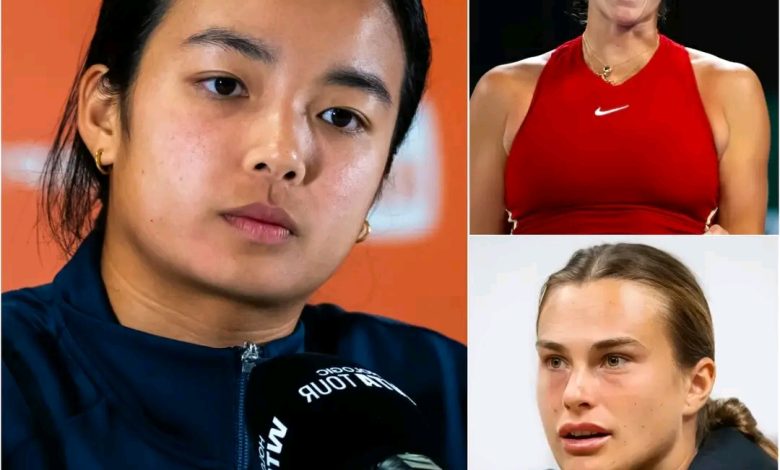
“YOU’RE JUST A STUPID ASIAN GIRL!” The tennis world was shaken after Aryna Sabalenka suddenly threw a tantrum and hurled racist abuse at Alexandra Eala in the middle of a chaotic press conference. Eala glared at her and responded with just eight sharp words: “Don’t look at me. Look at what I do.” — causing Sabalenka’s face to turn pale instantly. But just seconds later, Eala revealed a shocking secret about Sabalenka’s hidden past that no one expected… and completely turned the tables…
It began as a standard post-match media session. Both athletes had delivered fierce performances, emotions were high, and tensions simmered beneath the surface. But no one expected the incident that would dominate headlines for days. When a reporter asked Sabalenka about Eala’s rapid rise in the rankings, the Belarusian star’s expression changed—anger, frustration, and something darker flickered across her face. She grabbed the microphone and, without warning, snapped: “You’re just a stupid Asian girl!”
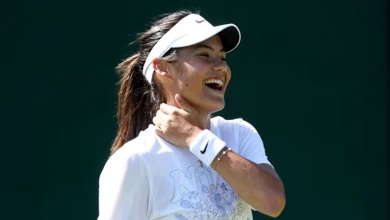
The room collectively gasped. Two security guards stepped forward, unsure whether to intervene. Alexandra Eala, only 20 years old but already known for her calm intelligence, did not flinch. Instead, she slowly turned her head toward Sabalenka, her eyes cold and steady, and delivered eight words that instantly shifted the power in the room:
“Don’t look at me. Look at what I do.”
The simplicity. The precision. The unshakable confidence. Sabalenka’s face went pale, and the cameras captured every second of it. Within minutes, the phrase went viral, spreading across social media platforms worldwide. Fans praised Eala’s composure, calling her “the quiet storm,” “the new face of mental strength,” and “the athlete who defeated hate with elegance.”
But the real shock came moments later.
Eala leaned forward, resting her hands on the table. Her voice remained calm, but the atmosphere tightened. “Since you brought up identity,” she said slowly, “maybe it’s time the world knows what you tried to hide.”
The reporters leaned in. Sabalenka stiffened.
Eala then revealed a secret that sent shockwaves not only through the press room, but also through the entire tennis community. According to Eala, Sabalenka had once been suspended from a junior European academy for verbally abusing another young player—an incident quietly covered up by academy management to protect her early career. Rumors had circulated for years, but no one had ever spoken publicly about it. Eala, however, possessed documents confirming the incident, including testimonies from two former coaches.
“Hatred isn’t new for you,” Eala said, her voice unwavering. “But covering it up doesn’t erase the past. It only delays the truth.”
The press room erupted. Reporters shouted questions; some demanded verification, while others frantically typed updates. Sabalenka tried to speak, but her voice cracked, and she slammed the microphone down before storming off the stage. It was the last time she appeared publicly for the next 48 hours.
Meanwhile, the Women’s Tennis Association scrambled to respond. An emergency meeting was held behind closed doors, and several board members reportedly pushed for an immediate investigation. Sponsors were alarmed, especially after hashtags like #StandWithEala , #NoRoomForRacism , and #SabalenkaExposed reached tens of millions of posts.
Eala, however, surprised everyone once again with her restraint. She released a brief statement through her team: “I said what needed to be said. Tennis should be a place for discipline, not discrimination.” Her words were quoted by major newspapers from Manila to Madrid, and several world leaders, including the prime minister of her home country, expressed public support.
Inside Sabalenka’s camp, panic reportedly grew. Some sponsors threatened suspension, and two PR representatives resigned. A leaked message from her agent suggested that “damage control may no longer be possible.” Meanwhile, the junior academy involved in the cover-up issued a rare public apology, confirming the truth of Eala’s claim without mentioning names.
But perhaps the most unexpected twist came late the next evening. Sabalenka, appearing exhausted and shaken, recorded a video apology. In it, she acknowledged her “unacceptable behavior,” admitted the past incident for the first time, and said, “Alexandra was right to expose me. I lost control. I let pressure become cruelty.”
The video did little to stop the storm, but many fans noted that Sabalenka had never spoken so vulnerably in her entire career.
As for Alexandra Eala, the young Filipino star returned to practice the next morning as if nothing had happened. Reporters shouted questions, but she simply waved and said, “I have work to do.”
Eight words started a global conversation. One truth revealed a hidden past. And a 20-year-old tennis player became the face of integrity in a sport shaken by scandal.