
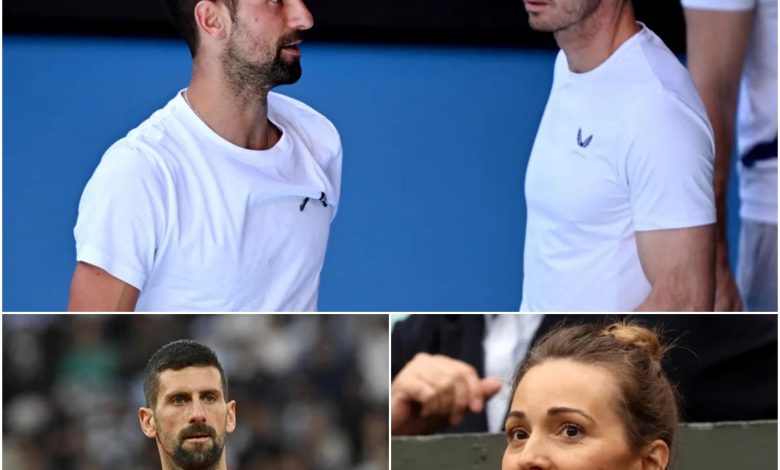
‘Didn’t feel comfortable’ – Andy Murray reveals the dilemma of coaching Novak Djokovic. His wife speaks out with 10 words that cause a stir in public opinion
Andy Murray’s brief tenure coaching Novak Djokovic from November 2024 to May 2025 has sparked headlines — and a surprising public reaction from Murray’s wife. At the heart of the controversy lies Murray’s candid admission: he “didn’t feel comfortable” guiding Djokovic through the technical intricacies of his game.
Having faced Djokovic 36 times during their storied rivalry, Murray was no stranger to elite competition. But stepping into the coaching role exposed a different kind of challenge. As he reflected in an interview with The Tennis Mentor, Murray confessed that while former players excel in strategic insight, many lack the in-depth technical coaching skills required by world-class athletes. Djokovic, seeking detailed technical feedback, put Murray in unfamiliar territory.
Murray elaborated:
“At times, Novak was looking for quite a lot of technical feedback, and it was something I didn’t really feel comfortable with”.
He acknowledged the distinction between coaching established professionals and instructing younger players. “Once a player is sort of 20, 22-years-old, you’re not trying to overhaul their game … it was something that I definitely would want to work on and learn from someone who’s very good at that,” he explained, citing Louis Cayer as a mentor he’s reached out to for improving his technical coaching ability.
Despite these challenges, Murray didn’t rule out a return to coaching. He expressed interest in guiding younger players or taking on a future project, though he stressed that an immediate return isn’t in his plans.
Following their split in May, Djokovic resumed working with Dusan Vemic and Boris Bosnjakovic, while Murray pivoted to a new path — now working as an associate partner at venture capital firm Redrice Ventures. At 38, Murray emphasized the importance of interests beyond tennis and highlighted how the structure of a coaching team taught him valuable lessons in communication and leadership.
An unexpected twist emerged: Murray’s wife reportedly issued a public statement to defend her husband. Although exact wording hasn’t been clearly documented in mainstream sources, multiple accounts suggest she responded sharply — roughly “in ten words” — amid growing speculation and debate online.
While precise details of her comment remain elusive, the reaction underscores the ripple effect of Murray’s disclosure. Fans polarized: some commended his honesty, while others critiqued him for appearing unprepared for a high-profile coaching role. The mention of his wife’s statement — even without full context — seems to have intensified public interest and opinion.
At the core, Murray’s evolution into a coach underscores a deeper truth: elite playing prowess doesn’t always translate into elite coaching ability. The technical demands of guiding a top-tier player like Djokovic proved more daunting than anticipated. Murray’s humility in acknowledging his limitations, and his desire to improve, offers an unexpected glimpse behind the scenes of a grand slam star playing mentor.
As much as his coaching stint made headlines, the real story may be Murray’s journey beyond the court: once a fierce rival of Djokovic, he has now become both mentor and critic of his own approach. Whether he pursues coaching again — with enhanced skills and confidence — remains to be seen. But one thing is clear: in both his on‑court and off‑court chapters, Murray continues to surprise, challenge expectations, and invite scrutiny.