
“Unfair Comment”: Fans in Disbelief as Alexander Zverev Takes Issue with ATP Chairman Over Painkiller Use
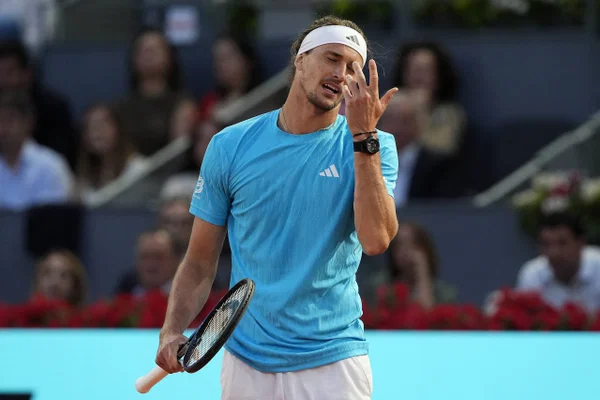
Alexander Zverev isn’t one to call for medical timeouts. But during his Australian Open second-round match in January, lower-leg pain made him fear an Achilles injury, prompting him to seek medical attention. A painkiller helped him continue. Months later, a separate ankle problem affected his serve against Carlos Alcaraz in the ATP Finals final, forcing him to alter his movement and play without his biggest weapon. So when Andrea Gaudenzi suggested that today’s players rely less on painkillers, Zverev had reason to disagree, particularly given the 60 injections he had previously mentioned receiving.
NITTO ATP FINALS: #1 ZVEREV STAYS PERFECT
“I think it’s an unfair comment from Gaudenzi because he doesn’t know how much painkillers we take,” he said during the German team’s press conference ahead of the Davis Cup. “It’s not like every time we take a painkiller we let him know. … I was much, much healthier this year than I was last year. Last year I was struggling a lot with my back. I had a lot of bone issues, as well, which I luckily figured out where it came from and I could take the medication for it.”
The 2026 season proved to be quite grueling for Alexander Zverev. He played a total of 88 matches (69-19), the most on the ATP Tour this year and 12 more than second-placed Daniil Medvedev, and wasn’t at his physical best on several occasions. As a result, he needed medical help to play through a number of his matches. After winning the French Open in June, he told German daily Bild that Dr Hans-Wilhelm Müller-Wohlfahrt had given him around 60 injections in December for his back, followed by two more rounds of 20 after the Rome Masters, so that he could play without pain.
So, it wasn’t a surprise that he openly dismissed the claims of the ATP Chairman, a former tennis player himself.
“Today’s players are much smarter than we were,” Gaudenzi said during a press conference at the ATP Finals. “We used to take anti-inflammatory drugs and go out on court even when we were feeling unwell. Today, they are right to take care of their bodies. Djokovic is an example of how you should approach things in this respect.”
Having been a top-20 player during the 1990s, reaching a career-high world No. 18 in 1995, Gaudenzi has firsthand experience of the physical demands of professional tennis. He drew on that experience to defend his comparison, revealing that he had played the final seven years of his career on painkillers. He also recalled injuring his shoulder during the Davis Cup final in Milan after taking a cortisone injection six weeks before it. Across 36 years in tennis, he added, he had three shoulder injuries.
As for what changed, Gaudenzi put it down to better science, smarter teams and medical progress, adding that players take prevention seriously because they want longer careers. They rarely play when an injury looms, which he called the right thing to do, instead of “overplaying and chasing the money.” For him, the responsibility lies with the players to manage their own schedules: only 12 events are mandatory, he noted, while Alcaraz and Sinner play around 75 to 80 matches a year.
However, his argument doesn’t fully account for the ranking and financial incentives that can make skipping tournaments difficult for players. Besides that, the major point of contention has been the growth of most Masters events to 12 days. Alcaraz has already urged Gaudenzi to do something about the calendar, saying:
“We need weeks to practice and to make the physical training. There are more important tournaments making us play more and more, so I really want to takes breaks. Who knows what will happen in the future, but if the ATP and [chairman] Andrea Gaudenzi has to do something if they want us to play a lot of important tournaments.”
Still, asked about players’ complaints, Gaudenzi added: “The data is very difficult, because obviously we see walkovers, but we cannot judge on a data point whether the player is not playing because he takes time off or he’s not playing because of injury. For us it’s difficult to flag in the database. But we haven’t seen injuries changing.” However, the PTPA disagrees.
An assessment of more than 30,000 matches found that upper-body injuries had risen by 42% in the first quarter of 2026 compared with the corresponding period in 2025. Arm injuries, meanwhile, were 112% higher than the 2025 average, Reuters reported. The association pointed to the findings as evidence of a growing problem, stating: “The data is clear: the season is too long, recovery time is decreasing.”
Alcaraz made a similar point ahead of the Davis Cup, saying that pushing yourself to play every week “ends up destroying you.”
Tennis stories that reveal another side of the painkillers debate
Boris Becker admitted in his 2003 autobiography, Wait, Stay a Moment, that the pressure to be the best and the grind of the schedule pushed him towards painkillers, on top of sleeping pills he took from 1987 until 1992. Loneliness, he said, fed a drinking problem. All of that led to a risky combination, as he regularly washed these pills down with beer and whisky to intensify their effects and numb his stress. So the debate is far older than this week.
In 2016, on the eve of the US Open, Reuters reported that over-the-counter anti-inflammatories were a bigger issue on the Tour than banned drugs, according to numerous players. Richard Gasquet, then ranked 15th, said he takes far more than people would guess, usually before matches rather than in practice, and assumed everyone does the same.
Goran Ivanisevic said he took them “like candies” when he won Wimbledon in 2001, and that if a doctor said take two, he took five, until the pills stopped working and he needed shoulder surgery. Mark Philippoussis called anti-inflammatories “like vitamin C for athletes.”
A 2017 BBC File on 4 investigation showed the habit runs through all of sport. A BBC poll found that 60% of amateur athletes took over-the-counter anti-inflammatories such as ibuprofen and naproxen at least once a week to help performance or recovery. Sports doctor Ajai Seth warned that leaning on them while over-training can slow bone healing and leave fractures that never mend, with heart problems, kidney failure and worsening breathing conditions possible over the years. Daniel Awde, a former Great Britain Olympic decathlete, took 13 or 14 tablets a day with a knee injury while chasing a place at London 2012, and said athletics circles joked about having ibuprofen “for breakfast, lunch and dinner.”
Nobody, though, has described the price of playing through pain and relying on pills more openly than Rafael Nadal.
In 2018, his uncle and former coach Toni Nadal told a conference in Murcia that a specialist had told the family in 2005 that Rafa’s career was pretty much finished because of a foot injury. From the end of that year, Toni said, Nadal lived with constant pain and often could not finish training sessions. Almost always he needed a painkiller during matches because the pain grew as they went on.
Toni spoke after Nadal had been forced out of the Australian Open quarterfinal by a hip injury and had also pulled out of Acapulco and Indian Wells. After that exit, Nadal had criticised the ATP over players’ workload, saying there is “life after tennis.” And in 2013, after a very good year, Nadal had already told his uncle he sometimes wished he would win less and have less pain.
Nadal confirmed the toll himself in May this year, after the Netflix series Rafa. He told the BBC he spent most of his career in pain, playing through a chronic foot condition. He was diagnosed with a rare disorder called Mueller-Weiss syndrome after breaking the foot in the 2005 Madrid Open final, months after winning the French Open on his first attempt at 19. The condition may have been caused by heavy training as a child. He still won 13 more Grand Slams in the next nine years, at least one every season, but said tennis became a race against time, never knowing how long the foot would last.
The damage, too, spread. Nadal developed tendinitis in his left knee and perforations in his intestines, which were linked to painkiller use. At times he relied on targeted anaesthetic injections and had no feeling in one leg during the 2022 French Open final, his last Grand Slam win. Nadal, who retired in 2024, said he made health decisions “on the borderline between right or wrong,” and that without them he would probably have won “10 fewer grand slams.” The suffering, he added, was less than his passion for the game.
The names and circumstances have changed, but the underlying problem hasn’t. Across generations, players have turned to painkillers to keep competing, often because stepping away comes with its own costs. From Novak Djokovic to Daniil Medvedev, several have suggested that the sport needs a reset. So as more players become selective about the tournaments they enter, the pressures driving those decisions need closer inspection.