
Sonay Kartal’s year of hell and fight back to British glory with unlikely partner-in-crime
Sonay Kartal should have been on the rise when a back injury wrecked her season. A former world No. 44 with one tour-level title and a run to the fourth round of Wimbledon under her belt, the Brighton-based star was denied the opportunity to build on that success in 2026, when a stress fracture in her back forced her to the sidelines for six months. Just when she’d found some momentum again, reaching the last 16 in Indian Wells, Kartal had to shut things down and put her tennis racket away. She missed three Grand Slam tournaments, including Wimbledon, and struggled to even brush her teeth when the pain was at its worst. Then, Kartal made a sensational comeback that nobody could have seen coming – not even herself.
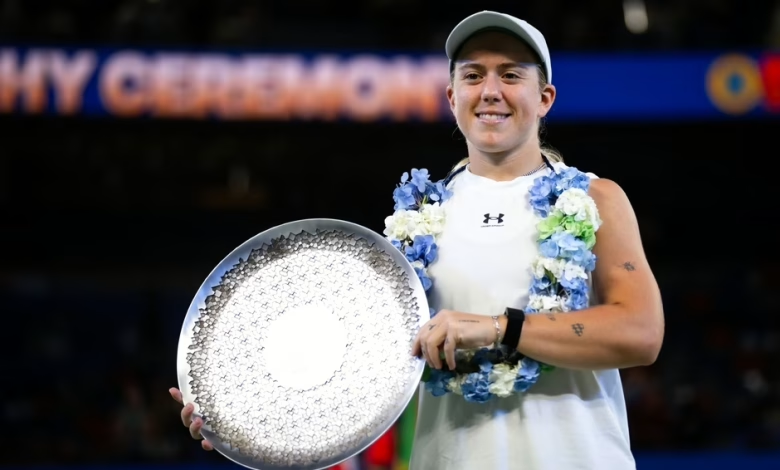
In just her third tournament back on tour, the 25-year-old reached the biggest final of her career at the WTA 1000 in Wuhan. She beat three top-15 seeds and a Grand Slam champion – Belinda Bencic, Jasmine Paolini, Elina Svitolina and Jelena Ostapenko. She went from No. 170 in the world to No. 49 in the space of seven days. She became British No. 1 for the very first time. It was something Kartal could have only dreamed of when she first accepted that she could be out for six months.
The first few weeks, I think I was a bit in denial myself. I think obviously [my team] know the injury much better than I do. They know how long I’m gonna be out for, ultimately, if I want to heal it correctly,” Kartal explained, speaking at the National Tennis Centre weeks after her Wuhan runner-up finish.
As home tournaments like Queen’s and Wimbledon came and went, Kartal found those missed opportunities tough to accept. “That was the worst. You’re constantly aiming for [a tournament] and you realise, actually, I’m a million miles off what I should be doing to be able to compete,” she said. “Even before that, like deep down, I knew. You just don’t want to believe it.
I think at that point I had to make the decision with myself because it was just a bit of mental torture each week, aiming for the next event. I just had to sit with the advice I had from the professionals and make a decision to just fully stop. Once I did that, it was almost like a relief off my shoulders. It was a much better place to be in”
At the beginning, there wasn’t much Kartal could do. Instead, she relished the opportunity to have a “normal life” at home in Brighton, going on walks in scenic spots in Sussex. According to her coach, the first eight weeks were “a lot of memes” and chat about food hotspots.
Then, Kartal’s rehab became something of a nine-to-five job. “The days were longer than they are for me now,” the current world No. 53 added. “My days were long, so my mind was always busy thinking about something.”
Kartal, who turned 25 last month, also had to deal with back pain that a regular 20-something-year-old shouldn’t be dealing with. “Probably the first month or so was just very uncomfortable. I had a lot of nerve pain too. I wouldn’t wish sciatica pain upon anyone. Back pain and nerve pain is not fun.
“I would just be doing normal things like brushing my teeth or bending down and putting my shoes on, and it’s in quite a lot of pain, which is obviously not fun. I think as a 24-year-old, not something I really wanted to deal with, which is another reason why I just had to let this get better.”
Kartal finally returned on September 22 at the Billie Jean King Cup Finals. She faced Czechia’s Marie Bouzkova, losing 7-6(2) 4-6 6-4. “[That] was probably one of the most distraught matches just because it’s a team event if you want to do everyone else, but if I take that out of it, I was very impressed with the level and very happy with what I produced,” she recalled.
“It’s tough mentally to go from playing all the time to playing nothing at all, just to keep that intensity during a match mentally, to stay focused the whole time. I really had no idea how I was gonna gonna play, I obviously had an idea how I hoped.
“When I made the BJK return, I didn’t expect to bring the level I did. Each match, I just kind of grew in confidence, and I felt almost as if I hadn’t really left. It was surprising to me how I felt.”
The Brit spent so much time on the sidelines that she was eligible for a protected ranking, which she used to enter WTA 1000 events in Beijing and Wuhan. Kartal reached the third round of the China Open on her return to the WTA Tour, and then went on a tear in Wuhan before losing to Maja Chwalinska in the final.
“I didn’t worry about ever getting back to that level. I just wasn’t sure how long it would take me,” Kartal explained. “Wuhan, I was going back-to-back, and I was just feeling great, I was getting the wins day after day, which is already an improvement and to do that so fast after having not played, it leaves me with a lot of confidence into next year.”
Kartal became British No. 1 for the first time in her career after reaching the Wuhan final, albeit for a week before Katie Boulter took over again. “She took it from me!” the world No. 53 joked. “It was definitely something ticked off that I’ve wanted to achieve for a very, very long time. I’m very aware that it’s going to come and go in my career. It was a proud moment for me and everyone that has had a part in my journey.”
One person who has played a crucial role in Kartal’s journey is her long-time coach, Ben Reeves. He began working with Kartal when she was just six years old, at the Pavilion and Avenue Tennis Club, tucked away on a residential street in Hove. While some players may seek new advice from experienced figures when they reach the professional tour, Kartal has remained loyal to Reeves.
“He’s known me since I was six. He’s a lot more than just a coach to me at this point. I think me and the rest of my family also see him like our family, too. He knows exactly how I work and how I operate, and vice versa, I know for him,” Kartal said.
“I think when I first came on the WTA Tour, there were a few questions of, ‘Are you going to get another coach? Are you going to get one that’s already done this kind of thing with a player?’ For me, it was never an option. It was a case of he’s got me from a red ball player to the WTA Tour. We’re both essentially rookies at this point, so why not? Let’s be rookies together and let’s try and do this. If he’s got a six-year-old to the WTA Tour, then why can’t he do more? That’s the trust I wanted to put into him and believe that he could do.”
And they have been rookies together. Reeves still gets “pinch me” moments on the tour, from run-ins with Roger Federer and Rafael Nadal to moments spent sitting inside big stadiums around the world.
“The very first junior Wimbledon, I opened the door, and Federer opened the door for me. Sonay came and got a picture with Federer. It’s such a good picture. I was in New York, I was having breakfast and Nadal was like sitting behind me and I was like taking a picture [over my shoulder], send it to my dad,” he joked.
“I guess you become a bit numb to it though, because it just becomes your reality. But still, when on a random Tuesday in an amazing country, I’m sitting in an amazing arena, they are pinch-me moments, for sure.
Reeves was working at another Brighton club at the Withdean Sports Complex when he first saw a six-year-old Kartal compete at a kids’ event. He then moved over to Pavilion and Avenue, and Kartal’s family entrusted him with coaching her. He knew from that moment that she was destined for the top 100.
“It sounds mad, but [I knew in] the first year of helping Sonay. You just see someone that’s so different in the best possible way. Just how they rise to challenges, even at a young age, and how quickly they pick things up. Just an extremely talented individual,” he recalled. “As the journey went on, I felt I can only do a bad job if I don’t get Sonay to be a top 100 player. I would have felt that I had done a bad job because she was extremely gifted.”
Kartal says her coach is more like family, and he feels the same. While the world No. 53 has been interrogated over their almost two-decade-long partnership, Reeves has never feared that Kartal would axe him in favour of a more experienced mentor.
“I never ever once worried about that, no. The family always trusted me. It wasn’t that I was even confident. It’s just the family put so much trust in me. And then when Sonay became a little bit older, she put that trust in me,” he said.
“And I think for us, it just happened. It just naturally just went from being No. 1 in your county, to then being No. 1 in your region, to then being No. 1 in your country. Just the stepping stones. We both had that growth mindset, and we were both evolving and learning together, and each new step, new journey, we were excited to do that together.”
Kartal’s rise has been just as life-changing for Reeves and his family, too. He and his wife have two children, an 11-year-old daughter and a four-year-old son, who also play tennis at Pav and Ave. Kartal made sure Reeves’ family were there for every step of her Wimbledon run last year, and he still makes the most of the moments he can be at home.
“It’s super tough. For any parent, it’s one of the toughest things to be away from your family,” he said. “They’re all my biggest fans, and Sonay’s. So as much as it’s hard, they make it easier for me by being so supportive. Also, it becomes the norm. I know at the school, the parents would be like, ‘Oh, I couldn’t do that if my partner was going away for so long’, but I think when you’re doing it all the time, it’s just your family life.
“I’m very fortunate that when I’m home, I get to pick up and drop off my kids. Weirdly, even though I’m away a lot, actually when I’m home, I’m much more present, and I’m able to be involved in the school life and do a lot of things that maybe dads working in London are not able to do. So it’s tough, but also we’re doing good with it.”
As Kartal continues her comeback in 2027 with Reeves by her side, both of them have a new goal – to be seeded at a Grand Slam tournament. “Beyond that, I think Sonay has the potential to have a great six months ahead of her where she was out injured. With doing so well in Wuhan, giving that sort of safety and those amount of points, I think a top 20 player for 2027 would be an achievable goal, 100 per cent,” her coach said