
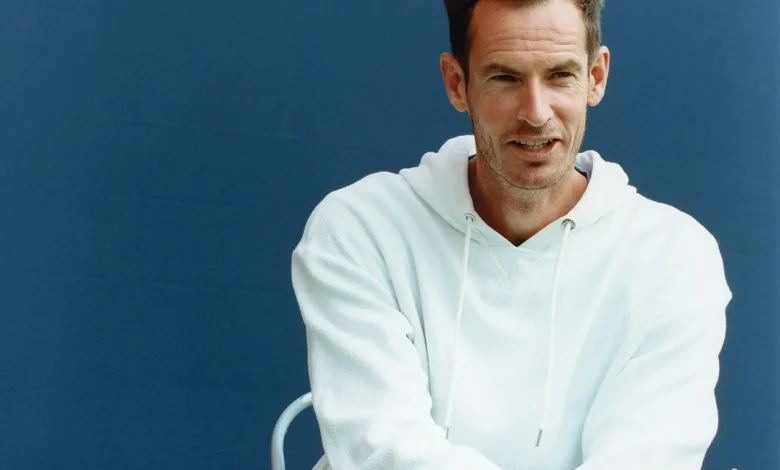
Andy Murray Opens Up About His Love Life in a Heartfelt and Emotional Confession, Revealing a Vulnerable Side Fans Rarely Get to See
Andy Murray’s kids don’t know what he does. “They think I’m a golfer, which right now is kind of true,” the three-time Grand Slam tennis champion says of his four children, aged between four and nine. “I think one saw a book that I’m in at school, so there’s an awareness, but I don’t think they’re really bothered.”
It’s 8am on a sunny Monday in June and we’re sitting across from each other in a booth inside the players’ area at Queen’s Club. A framed picture of Pete Sampras is just above Murray’s head, facing one of Rafa Nadal above mine. Murray places his phone and car keys down on the table. Attached to them are two mini Wimbledon trophy keyrings (“My wife gave them to me”). He’s just given me a bit of a guided tour of the place: “The nail bar is new, and so is the sparkling water refill machine,” he says, waving at someone who turns out to be Laura Robson. She’s the tournament director for this week’s women’s event, which is returning to Queen’s after a 52-year hiatus.
Murray’s brother Jamie occupies the same role for the men’s event next week. “A lot of the tennis tournaments now have ex-players as tournament directors because they recognise things that people who didn’t play might not,” says Murray. “I did actually have my nails done once at an American Express booth at Wimbledon. They were very good. They did tennis balls and strawberries and cream on mine.”
It’s nearly been a year since Sir Andy Murray (“‘Sir’ is like what you call a teacher or a grandparent”) changed his Twitter/X bio to “never even liked tennis anyway”, retiring from the sport he’s loved and excelled at since he was seven. “Right now, I don’t really do anything. I’m a father, essentially,” he says. “I used to have to explain [to them] that I’m going away to play a tournament. They liked it when I lost, because that meant I was coming home. Today, I had to say ‘Sorry I can’t take you to school.’ But I didn’t say that I was coming here to…” He trails off humbly, a true Andy Murray trait, which his fans have grown accustomed to seeing over the years.
If he can’t, I’ll tell you why we’re catching up at Queen’s – because today Murray will begrudgingly open a court that’s been named in his honour: the Andy Murray Arena. “I’m aware it’s a really cool thing,” he says, slightly embarrassed. “It feels a bit weird it’s named after me but I’ve had amazing memories at this place.”
He’s as humble at home as he is in public; the only evidence of his tennis exploits exist in the downstairs loo. “There’s like nine pictures, but they’re not of me standing there with a trophy. It’s me with my team. There’s one from when I was playing in the Davis Cup, Great Britain on my back… and a shot from behind where you can see the crowd. Just moments like that with people I was working with,” he says. Most of his trophies are in the basement. One of his Olympic gold medals is in a museum in London for the year, and he’s thinking about donating some trophies to somewhere in Dunblane, where he grew up. “I’m not sure what to do with them but I like them being there,” he says.
GQ: It’s approaching a year since you played your last ever competitive tennis match. Is your career already a blur?
Andy Murray: I did a speaking thing a few weeks ago and they put up a few highlights from my career. Honestly, it feels so long ago, even last summer when I played at the Olympics [with Dan Evans] and Wimbledon [with his brother]. I haven’t really missed it but I’m curious to see if that changes because I love this time of year. I loved playing Wimbledon and here at Queen’s, so if I’m going to miss it, this would probably be the time.
Has that surprised you?
I’d spoken to my team and my family and psychologists about when the time comes to step away. Essentially I spent my whole adult life playing tennis most days, every single week. So not having it, I wasn’t sure how I was going to deal with it, and was expecting it to be quite hard. It’s actually been the opposite so far. Why that is, I’m not entirely sure. I don’t know if it was because it was just the right time, or maybe I put everything that I could into it. There are no massive regrets. There are some results I would like to change the outcomes of, but I tried my best and got the results that I got.
Did you end up retiring how you had envisaged it?
I had these great ideas that I wanted to retire in a specific way, and it happened totally differently to what I expected. It wasn’t about winning a title and having this Hollywood ending. The last match I played at Wimbledon was doubles with my brother. We lost in the first round on Centre Court and I could barely feel my foot on my left leg. I would have liked to be able to play a little bit better, but when I reflect on it, that was a great way for me to finish.
Are there any career moments that stand out in your mind?
A lot of them are big losses. When I lost the Wimbledon final in 2012, I remember I was very, very upset after that. My memory of that is quite different from when I won [the following year]. Then I was just so relieved, and didn’t really feel like I enjoyed that moment. It’s not a result I regret, but more the aftermath of not enjoying that moment more and not spending it with the people close to me. I got pulled in a lot of different directions, and wish I’d spent that time a bit differently.
Do you ever think what might have happened if you hadn’t won Wimbledon the following year?
When I was playing, I did. But now I look back and I’m like, ‘Why did I get so worked up about those things?’ Literally within a couple of weeks of finishing, my whole perspective on results and performance and everything changed. When I look back at my career, I feel a lot more proud of my achievements, whereas when I played, it was always about wanting more. When I won the US Open [in 2012], the question I would get asked was, ‘When’s he going to win Wimbledon?’ so you end up doing it yourself as well. You don’t take a moment to just pause and be like, ‘Wow.’ Had you offered me this when I was a 15-year-old growing up playing tennis in Scotland, this is beyond any of my dreams.
Did you fulfill all your dreams?
When people get asked what they wanted to achieve in tennis as a kid, everyone says, ‘Oh, I dreamt of winning Wimbledon’ or ‘I dreamt of winning the Davis Cup’ or whatever it is. I don’t know how true it is when people say that, but for me, I wanted to get into the top 100 in the world and play on the professional tour. That was it. It wasn’t to achieve the pinnacle.
Are you proud of the moments you gave British sports fans?
I appreciate them when I see the videos of people watching all around the country. But when I was playing, I had no idea that sort of thing was going on. I do feel very proud that I was able to deliver those moments, but at the time, for me, I didn’t feel great.
How important a part has your wife, Kim, played in your success?
She’s been a huge support and a massive, massive part of my career. When you’re playing, you don’t always appreciate that. I think a lot of individual athletes – me included – would be selfish at times. You think a lot about yourself and your own performance, and your mood is reflective of whether you;ve had a good match. Say, I won. I’m in a good mood. I lost, I’m in a bad mood. It’s not really fair on the people around you. But even at the end, when I was struggling physically and was not winning many matches, and we had young children, Kim was always so supportive of me continuing to play because she knew I loved the sport and loved playing.
Are there any moments where you put tennis over your relationship and wish you could change?
When we got married, our honeymoon was in Barcelona, and I was doing a training block. Essentially, we got to spend a couple of nights with each other, but I was practising during the day, training and going to the gym and doing all my physio work. [A honeymoon] is very important for most couples. Maybe for her it was too, but she was willing to sacrifice that to allow me to chase my goals. She’s super important to everything I achieved, so now I’m trying my best to make up for all that.
Have you thought about organising another trip to Barcelona?
That’s actually a good point – I should probably take her somewhere. I’ll do that, maybe in a couple years, when the kids are a little bit older.
What about your mother, Judy? Do your kids know the role she played?
They wouldn’t know that my mum is a tennis coach – they just see her as Nana. From time to time we go out to see her in Scotland, and they’ve always loved going. My memory as a kid is that Mum would just play games with us all the time. She does the same with our kids. She’ll go and swim with them. She’ll go and throw water balloons with them. She’s very creative with games. She’s essentially worked with children most of her adult life, so she knows how to entertain them.
Murray needs a loo break – this one doesn’t feel tactical. Perhaps it’s the thought of all that fizzy water on tap. When he comes back, I notice he’s wearing the same white Paul Smith trainers that he rocked last week at Roland Garros for what was a long overdue public appearance with Roger Federer, Novak Djokovic and Rafa Nadal, to celebrate the latter’s incredible French Open record.
“They were a birthday present from my wife, so I felt like I had to use them for a special occasion,” says Murray of the shoes.
What’s it like being regarded as one of tennis’s Big Four?
It’s always difficult, because I’m aware that what those guys have achieved is far greater than anything I achieved. That being said, the reason why people started calling it “the big four” was because in every major event, whether it was Grand Slams or the Masters Series, two, three or four of us were always in the latter stage of events, competing to win the biggest tournaments. When I had my hip injury [in 2017], I was ranked No 1 in the world, and unfortunately afterwards I was not able to get back to where I was. But there was a period from when I was 22 to 29 when I was in the mix at most of the major events with those guys. I had some amazing matches with all of them [he lost five Grand Slam finals against Djokovic and three versus Federer]. There was always a possibility that I could win, and in many ways tennis fans who watched that period knew it was a great time to play, because you had three of the best players of all time, playing in one period. I was the plus one, unfortunately. When I look back at the fact that to get over the line at Wimbledon, I had to beat the best men’s player of all time [Djokovic], I’m proud I managed to do that.
Can you rank the Big Four in terms of crying?
I think Federer is the best. Then me. Then, that’s actually a pretty tough one, because you don’t really see Rafa or Novak crying that much. I would probably say it would be Novak, and then Rafa. I’ve probably seen Novak break down a few more times.
How important is it to see grown men expressing their emotions openly?
A lot of people speak to me about this, especially after the Wimbledon final [I lost] in 2012. It was really important for how I was viewed, because it showed that I was human. When I started playing as a professional tennis player, I went from nobody knowing me to lots of people knowing me in the space of a few months. All of a sudden, people are commenting on how you speak, how you look, how you act, commenting on your tennis and your potential. You feel like you’re being judged by everybody. So it is a human reaction to become defensive and guarded. I found the whole fame thing difficult, and I didn’t feel like the media tried to understand that. So that time at Wimbledon was the first time where I really showed my emotions to the public, and from there I probably felt a bit more comfortable opening up.
You suddenly had influence, as a public figure.
I feel like there’s a responsibility to think before speaking, and to make sure that what I’m saying is respectful and appropriate, and not speaking down about people. But I don’t actively want to be going out there and telling people what they should be doing or how they should be thinking.
Is that why in 2017, you called out that journalist for being sexist?
He asked me a question about American tennis not being that successful. At the time, when you looked at the last 15–20 years, Serena Williams had won the most Grand Slams out of anyone, male or female, and Venus had won seven or eight Grand Slams, so it was probably the most successful era in American women’s tennis, but it was almost like that was forgotten. In that moment, it was just instinctive.
Is sexism something you’ve always been aware of in the sport?
I never used to think about it until I hired a female coach, Amélie Mauresmo. It didn’t get very well received by the locker room and by my team at the time, which is fascinating because she was ranked No 1 in the world, and won multiple Grand Slams. Had it been a male ex-player, that would have been an amazing hire, but it was the opposite reaction. I asked my mum questions, because I’d never really spoken to her about that stuff before, and she obviously had experienced lots of different issues, being a female coach in sport for a very long time. So then I would notice when people ignored or forgot achievements of female players or athletes, and I was able to pick up on it a little bit.
We are now out on one of Queen’s grass courts to shoot some portraits. Murray, far more natural in front of the camera than he’d ever let on, has just shared with me that his Border Collie recently passed away. It caused his family a lot of grief and pain – so much so that he’s been persuaded to get a new one. It means that as well as his newfound love for playing golf – he played in his first competition yesterday (“I did end up shouting ‘Fuck’ on the 15th tee”) – he’s spending a lot of his free time training a puppy, and making sure it doesn’t jump on the sofa.
Now you’re retired, do you feel the need to stay in the public eye?
I’m not thinking daily that I need to tweet something today, or somehow remain relevant. That’s why I’m much more interested in the idea of coaching, because I feel like I’d actually really be helping someone. Whereas with punditry, it can be harmful. If I go and work at, let’s say Wimbledon, you start getting asked questions about British players like Jack Draper. I know when the British ex–tennis players would talk about my tennis and what I should be doing. Because you respect them, you listen to what they’re saying – but it’s not always the same as what your coach is telling you. What the pundits are saying could be wrong. They’re not right all the time, and when you’re young, it’s quite conflicting. So I’d be more inclined to do coaching, because I think punditry is quite an easy gig. You can just throw stuff out there. People love it if it’s a bit controversial, but you don’t actually have any skin in the game.
So you’re not going to be the Roy Keane of tennis?
Interestingly I love Roy; I would love to see him coaching. People like that have so much to offer to actually really help people.
What did you learn from being Novak Djokovic’s coach for six months?
He’s got a team of people from different cultures and backgrounds – Serbian, Austrian, Spanish – so it was a different way of working. Learning to communicate well to everybody and how to deliver your message; how you speak to [Novak], trying to understand what makes him tick, what motivates him. As the lead coach, when something goes wrong, essentially it falls on you. You are having to coordinate everything – arranging the practice courts, making sure the rackets are ready – so it’s a bit more stressful throughout the day to make sure that things go smoothly. It was interesting, but definitely lots for me to work on.
And you’re about to embark on a stand-up tour of sorts.
[laughs] This wasn’t something I was keen on as an idea, but my team suggested it a few times. One of the things I struggled with in interviews was that essentially everything I said publicly since I was 18 was recorded, and a lot of it can’t be undone. So getting the chance to go and speak to my fans in private settings where hopefully I’m comfortable enough to open up and talk about some of the difficult moments of my career, some of the great moments in my career, will be a nice thing to do.Does having kids make you think more about your own upbringing?
There’s things that you remember as a child that you loved, then there’s things that you didn’t enjoy as much. Unfortunately, my parents got separated, and that’s something that as a kid is hard. I don’t want that for my own family. Things like Christmases, I genuinely don’t remember any of the presents that I got – I remember being with my family and playing Scattergories and Pictionary. When you become a parent, you start to think a bit more about the nice things you did as a family, and you want to try and recreate them for your own children. And the things you didn’t like, you make an effort to avoid.
Did your mum beat you at the board games?
Yes, and I wasn’t a good loser, though I don’t remember tipping the board games up.
Have you taught your kids the difference between winning and losing yet?
When I was 19, I used to live with one of my coaches, and I would go out on the scooter with his kids, two young girls. We would race and I would never let them win. Now, with my own kids, I don’t lose every time, but I let them win enough that they feel like they can win. I don’t know whether you should do that or not. It’s trying to get that balance right. It’s interesting, because I never thought I would have been like that.
What about the Dunblane tragedy at your school in 1996 – over the years is that something you’ve been able to open up a bit about?
It is something I think about, especially around that time of year [mid March]. As a family, we never really spoke about it, to be honest. It’s quite a hard one for families to know exactly how to deal with, but certainly in the last eight years, I’ve spoken more to my family about it.
Have you thought about it differently being a parent yourself?
I don’t necessarily think it changes the way that I would parent, whereas Adolescence is something my wife and I have been very conscious of. We want to make sure we get that side of parenting correct, because I think being on social media from a young age can cause issues. It’s not fair on the children, because they’re tapping into a part of their brain that they can’t control.
Something that hypothetically you could control – who would play you in a movie?
It would have to be Andrew Garfield, because people say we look similar. That’s my celebrity lookalike.
And what about your mum?
I don’t think she’d be happy about it, but who played Cruella de Vil? Glenn Close? Let’s go with her.