
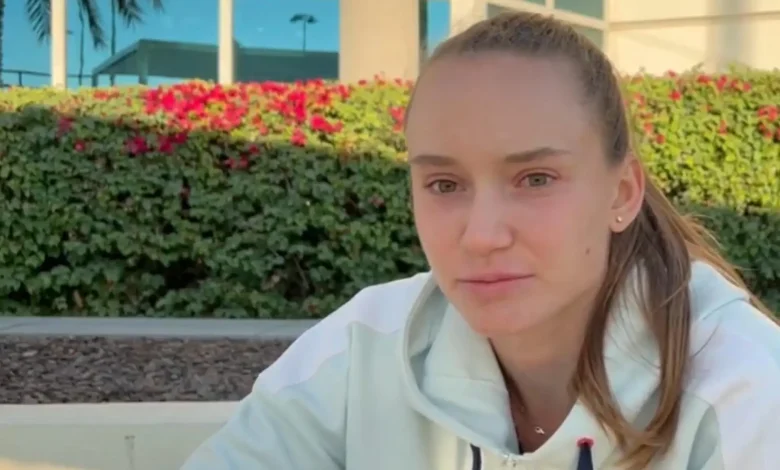
BREAKING: Tennis Fans Left Heartbroken as Elena Rybakina Admits She Feels ‘Kind of Destroyed’ After an Exhausting Toronto Run
Elena Rybakina came very close to adding another big title to what has already been a strong 2026 season, but her body finally appeared to run out of energy at the Canadian Open.
The world No. 2 reached the Toronto final after a demanding week in which four of her five victories went to three sets. She had to come from behind against Naomi Osaka in the quarterfinals and then recovered from losing the first set to beat Coco Gauff 5-7, 6-2, 6-2 in the semifinals.
Those matches came after a difficult period for Rybakina. The 27-year-old won the Australian Open at the start of 2026 and later lifted the Stuttgart title, but she then went through a less convincing run. She suffered early Grand Slam exits at both Roland Garros and Wimbledon before finding her level again in Canada. The WTA noted that Toronto ended a stretch in which the Kazakh had gone 9-6 after Stuttgart.
By the time Elena faced Iga Swiatek for the Canadian Open trophy, however, there was very little left in the tank. Swiatek won 6-2, 6-3 to claim her first title of the season, while the Australian Open champion was unable to produce the same intensity she had shown in her previous matches.
Rybakina explains what went wrong against Swiatek
Rybakina had spent close to 13 hours on court during the tournament, and she made no attempt to hide how tired she was after the final.
Asked whether all those long matches had affected her against Swiatek, the two-time Grand Slam champion admitted that fatigue was a big factor.
“Yeah, I think it was a big, how do you say? I mean, I was just very tired,” Rybakina said.
“You could see that I wasn’t pushing with the legs enough.
“There was a lot of unforced errors, especially on top of the net.
“It was just pure lack of concentration. Even on those kinds of easy balls, too.”
The numbers also showed how difficult the final was for the 27-year-old. Rybakina made 23 unforced errors compared to only eight from Swiatek, while the Pole converted four of her five break-point opportunities.
Elena still stressed that the quality of the opponent also played an important role.
“So, yeah, of course, Iga, she’s a tough opponent, and she was trying to get all the balls back, of course,” she said.
“So, yeah, it was difficult for me today, and, yeah, I just hope that I take all the lessons and somehow next time going to do better.”
There was another concern during the match when the world No. 2 appeared to be stretching her arm.
When asked afterward what exactly was bothering her, Rybakina joked that it would probably be easier to say which part of her body did not hurt.
“Well, I’m not sure if I can tell you what is not hurting, actually!” she said.
“I feel kind of destroyed, of course, now.
Especially when the tournament is finished, you feel kind of everything even more.”
Despite that physical condition, the Kazakh felt she had dealt with Toronto’s difficult schedule better than at some previous tournaments. Her matches were played at different times of the day, and her semifinal against Gauff finished particularly late.
“I think that this time I actually did better with the scheduling, because I was playing a lot of matches in the morning, during the day, and then at night,” Rybakina pointed out.
“It was just very much a pity that I didn’t have enough to push this last match even more.”
Experts have been impressed by Rybakina when she is healthy
Although the final ended in disappointment, there were plenty of positives from Toronto. The WTA described Rybakina’s victory over Osaka as a display of “champion’s grit,” while her semifinal victory over Gauff gave her a tour-leading 26 hard-court wins in 2026 at that stage of the tournament.
Her performances this year have also backed up what several experts said before the season began.
Sky Sports tennis expert Gigi Salmon picked Rybakina as one of the players to watch in 2026 after her strong finish to last season. Salmon stressed that when the Kazakh is fit and playing well, her game can make her almost impossible to stop.
That prediction quickly looked accurate when the 27-year-old defeated Aryna Sabalenka in the Australian Open final to win her second Grand Slam title.
Martina Navratilova was also impressed by the way Rybakina handled that match. The 18-time Grand Slam champion pointed out that Elena produced her best tennis when it mattered and was mentally stronger than Sabalenka in the decisive moments.
Before the season, WTA writer Greg Garber had also predicted that Rybakina would win another Grand Slam in 2026, stressing that her power can be overwhelming when she is healthy.
Such predictions certainly represented a strong motivation for the Kazakh tennis player, but at the same time, they also brought serious pressure. Rybakina is always expected to achieve the highest goals, so it can sometimes be difficult to dominate under such conditions. Despite everything, Rybakina has shown that she is determined to keep fighting for the biggest trophies, hoping to succeed not only this year, but also in the seasons ahead.