
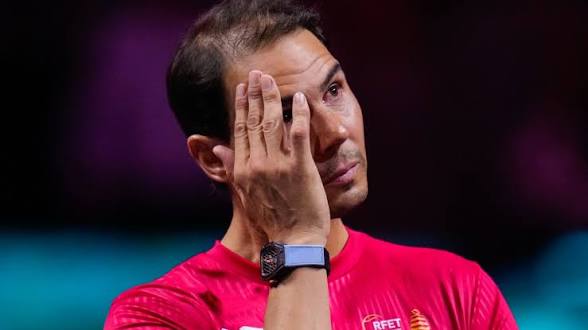
Rafa, the recent Netflix documentary, shows the tennis great’s Achilles’ heel and offers a meditation on suffering and success
Tennis great Roger Federer will be remembered for his elegance, and his peer Novak Djokovic for his willpower. Rafael Nadal, though, will go down in history for his extraordinary ability to endure pain. That pain, finds Netflix’s newly-released documentary Rafa, remained the celebrated Spaniard’s near-constant companion from 2005 until his retirement in 2024.
Through this pain, Nadal persevered to become one of tennis’ greatest champions. His victory graph is staggering: 22 Grand Slam titles, including a record 14 French Open victories, and the distinction of becoming the first male player to reach World No. 1 across three different decades. Yet Rafa is not just a simple celebration of these achievements, but an exposition of the physical price paid for it. Through a steady procession of MRI scans, medical consultations, rehabilitation sessions and visible moments of discomfort, the documentary reveals the relentless toll exacted by greatness.
Released at a time when contemporary culture is increasingly questioning narratives that glorify suffering as the price of success, Rafa leaves viewers with uncomfortable questions. When the pain is this persistent, is the pursuit of greatness still worth it? Also, can greatness be a balm to pain?
Dismantling the Myth
Having watched Nadal play since 2007 on a hundred screens, I remember him differently. For a devoted Federer fan like me, Nadal always seemed less human, more bestial—a force of nature who would not let his Swiss peer be. A teenager in white capris, muscle T-shirts, a bandana holding his long hair back—Nadal was a heartthrob who rarely smiled. Compared to Federer’s ballet-like moves, a ripped Nadal would throw himself at the ball, unafraid to slide on the court to not miss a point. The image of the bull’s horn, that would eventually become his Nike logo, felt almost inevitable. He attacked every point with such ferocity that the idea of the Spaniard wrestling pain was unfathomable. Rafa dismantles that mythology.
The word “suffering” recurs throughout Rafa with high frequency. It comes from coaches, physiotherapists, family members and teammates, all of whom seem to agree on one thing: Nadal was unusually comfortable with discomfort. More than that, he seemed to derive meaning from it. Suffering, in the Nadal universe, was a necessity for success. Beneath the trophies (and his famous ticks) and records lies a man carrying anxiety, doubt and exhaustion.
The documentary traces Nadal’s mindset back to his childhood under the watchful eyes of his uncle and longtime coach, Toni Nadal. For nearly three decades, Nadal’s beloved Toni shaped his game and also his philosophy towards effort with rest rarely being encouraged. Unlike other famous athlete-coach family dynamics (think Serena Williams and her father) that have often attracted scrutiny, the relationship between the Nadals was rooted in mutual trust and a thirst for what the zenith of tennis glory could offer. Glimpses of Nadal’s family—especially his children—also help in seeing the softer side of the man who grimaced through pain, his entire career.
What makes this devotion remarkable is the body through which it was achieved. Nadal spent most of his career managing Mueller-Weiss syndrome, a degenerative foot condition that required him to compete on the court with customised insoles, constant pain and consistent medical supervision. His foot issues triggered a chain reaction: knee problems, abdominal tears, rib injuries, chronic hip pain and eventually the pelvic and hip problem that accelerated his retirement. At one point, Nadal’s physiotherapist looks at a sudden lump on his foot after a match questioningly. “It doesn’t hurt,” says Nadal, with his trademark shirk. The documentary’s parade of MRI scans, treatments and rehabilitation sessions makes one thing abundantly clear: Nadal’s greatness was achieved through throbbing, persistent pain.
The reason, perhaps, for this give-it-all behaviour was that he never knew which game would be his last. The documentary’s greatest achievement is that it humanises the beast while celebrating his resilience.
With his uncle and longtime coach Toni Nadal.
Is It Worth It?
For decades, elite sport has postulated the idea of greatness demanding sacrifice. From tennis champion Maria Sharapova sacrificing growing up with her mother in Russia to train with her father in the US, to a more extreme case of Australian hockey player Matt Dawson amputating a part of his finger to get rid of an injury in time to play for the Olympics in 2024—are only two such examples. The same philosophy has infiltrated workplaces, schools and popular culture through quotes that equate suffering with achievement. But contemporary culture is increasingly skeptical of such narratives with younger generations questioning burnout, overwork and the absence of leisure as measures of personal worth. The old maxim of “no pain, no gain” no longer goes unchallenged.
Viewed through this lens, Rafa becomes a more nuanced view. The documentary never criticises Nadal’s decisions; nor does it diminish the magnitude of what he has accomplished. In fact, every Federer fan worth their salt will also admit that it is impossible to dislike Rafa. Both–close friends in real life–are the best that tennis has had to offer in my lifetime. Yet, the documentary is a searing truth-teller that refuses to romanticise the consequences of Nadal’s greatness. Every victory appears shadowed by recovery and every comeback carries another physical cost.
By its final episode, Nadal seems less concerned with winning than with certainty. Certainty that he has given his all. He wants to know he has exhausted every possible route back before walking away—even at the cost of not announcing his departure from the sport at his favourite court in Paris. His retirement is presented as acceptance of him suffering without an end because until then, he had suffered to make it to the next match. For Nadal, peace comes from knowing there is nothing left in him to give.
The power of Rafa lies in its reluctance to offer easy conclusions. The viewer is left admiring Nadal’s achievements while simultaneously recoiling from the price they demanded. In exposing that tension, the documentary humanises one of sport’s greatest competitors more effectively than any celebration of trophies ever could. And perhaps, that is the uncomfortable question at its heart. If greatness requires this much suffering, would we still choose it for ourselves?