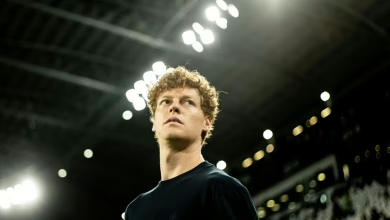


In a world where sporting heroes are often measured by trophies and rankings, Andy Murray has delivered a reminder that true greatness is not only written in record books—but in human lives.
The former world No.1 stunned fans, fellow athletes, and global media this week by announcing that he has donated his entire $12.9 million in prize money and sponsorship earnings to build a network of homeless support centers in his hometown of Glasgow. The ambitious project will provide 150 permanent housing units and 300 emergency shelter beds, designed to protect vulnerable people from Scotland’s brutal winters.
But beyond the numbers lies something far more powerful: a deeply personal mission shaped by compassion, memory, and heartbreak.
A Champion Moved by the Streets He Once Walked
Standing before reporters, Murray was visibly emotional. His voice wavered as he explained why he could no longer look away.
“No one should ever have to sleep outside in that kind of cold,” he said. “Not in this city. Not anywhere.”
Those who know Murray well say this decision did not come from a moment of publicity—but from years of quiet reflection. Growing up in Scotland, he saw homelessness not as an abstract social issue, but as a reality that existed on streets he traveled every day. Over time, that awareness became impossible to ignore.
This was not charity for appearances. This was a reckoning.
From Grand Slams to Glasgow’s Coldest Corners
The funds will establish a comprehensive support network across Glasgow, combining housing, emergency shelter, mental health services, and job-readiness programs. The facilities are designed not merely as temporary solutions, but as pathways back to dignity.
The project will include:
150 long-term housing units for individuals and families transitioning out of homelessness
300 emergency shelter beds for those at immediate risk
On-site access to counseling, healthcare referrals, and employment support
Community leaders describe the initiative as one of the most significant private humanitarian investments in the city’s modern history.
“This Isn’t About Tennis Anymore”
In a sport defined by endurance, pain, and sacrifice, Murray’s career has already been a story of resilience—from career-threatening injuries to emotional comebacks. But this moment, many believe, may define him more than any championship.
“This isn’t about tennis anymore,” he said quietly. “This is about people. About making sure that when winter comes, someone doesn’t die just because they had nowhere to go.”
His words struck a chord far beyond Scotland. Social media flooded with messages of admiration, with fans calling the act “legacy-defining,” “humbling,” and “what leadership should look like.”
A City Responds
Local charities and city officials confirmed that construction planning is already underway, with the first center expected to open within the year. Volunteer organizations have pledged to staff and support the initiative, while additional donors have reportedly come forward in response to Murray’s announcement.
One outreach worker in Glasgow summed it up simply:
“This will save lives. Not someday. This winter.”
The Meaning of True Victory
Andy Murray’s career has been defined by battles—on court, in his body, in his mind. But in giving away what many would guard as personal fortune, he has redefined what it means to win.
There will always be highlight reels of his backhands, his titles, his moments of sporting brilliance. Yet for hundreds of people who will now sleep indoors, eat warm meals, and rebuild their lives, his greatest achievement will never appear on a scoreboard.
It will be felt in the warmth of a room.
In the safety of a bed.
In the quiet survival of winter nights.
And in a city that will forever remember the day its greatest champion chose humanity over wealth.