
Ruined Everything For Me: Mirra Andreeva Left Reeling as Andy Roddick Breaks Down the Truth Behind the Controversial ‘Fake’ Serve
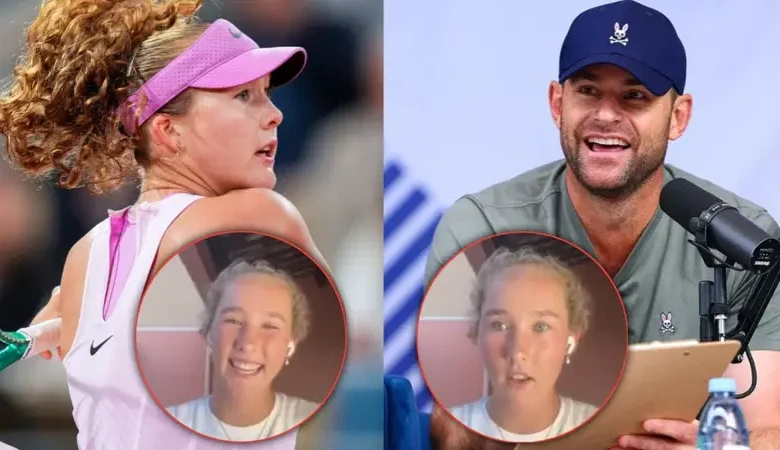
Mirra Andreeva just couldn’t believe it when she heard that a serve that she wanted to emulate was from a commercial. Andreeva sat for a chat with Andy Roddick on his Served podcast, and among other things, they discussed the 43-year-old’s serves.
The teenager praised Roddick’s serve, referencing a 2006 Powerade commercial. In that commercial, the American smashes an ace, but the ball, after hitting the clay, gets stuck there instead of bouncing.
Mirra Andreeva told Andy Roddick
The 19-year-old, alas, had no idea that the video was from a commercial. While she was talking about emulating Roddick, the former ATP World No.1 was shaking his head before he dropped the truth bomb. He said:
So Mirra, what you just referenced is fake. The ball didn’t get stuck. It was a commercial. It was a secret for a long time. They cut the top of the ball off. It wasn’t even clay. They painted it orange, and then they put makeup around it.
Andreeva was all smiles during the conversation. But upon realizing the video was from the commercial, her expressions changed into one of shock and disbelief.
You’ve just ruined everything for me. Oh my God! Wow! I’m a little bit disappointed, to be honest, but okay, it’s the truth.
Mirra Andreeva said
Roddick called time on his singles career in 2012 after winning the 2003 US Open and reaching four more Grand Slam singles finals. In his career, Roddick smashed 9074 aces in 776 matches, the sixth-most in the all-time list in the Open Era.
Andy Roddick lauds Jannik Sinner’s calm and composed attitude before Major finals
After clinching the Wimbledon title, Jannik Sinner took a much-needed break and recently withdrew from the Canadian Open, choosing to prioritize his health instead of chasing the historic Golden Masters. He is expected to be back for the Cincinnati Masters, where he handed the walkover to Carlos Alcaraz last year due to an illness.
Andy Roddick had already guessed about Sinner’s withdrawal decision after a brief conversation with the 24-year-old at Wimbledon. Roddick has always spoken highly of the five-time Grand Slam champion. And in an episode of his Served podcast, Roddick talked about one quality his former rival Roger Federer and Sinner share.
Jannik is the most relaxed person I have ever seen, apart from Roger Federer, before a Major final. He seems to exude a serene confidence in how he approaches things. Even his celebrations are unlike anyone else’s. You could tell he was ready to do it all again an hour after the US Open, which is a problem for the rest of the world.
Before defending his title at Wimbledon with a four-set win over Alexander Zverev, Sinner crashed out of the French Open, losing to Juan Manuel Cerundolo in the second round.
But before the clay-court Major, the Italian ace scripted history by winning the Italian Open, making him the second man after Novak Djokovic to complete the Career Golden Masters. He is on a 34-match winning streak in the Masters 1000s, thanks to his win in Paris last year and the five titles he won at this level this season.
Following the Cincinnati Masters, the five-time Grand Slam champion will be chasing his second US Open title. He failed to defend the title last year, losing in four sets to Alcaraz. Sinner won his second Major in New York back in 2024 by beating home favorite Taylor Fritz.