
“I have given everything for the Philippines—please don’t say that I am selfish.” Alex Eala seemed to cry out, unable to hold back her tears as she was doubted by the very people she loved and devoted herself to. Every powerful shot was a fight for justice and clean sport, yet this battle felt like a trap. “They fabricated baseless accusations just to push me out of the race,” she said. Shortly afterward, Alex released an official statement that made everyone cry out in regret, begging her to stop

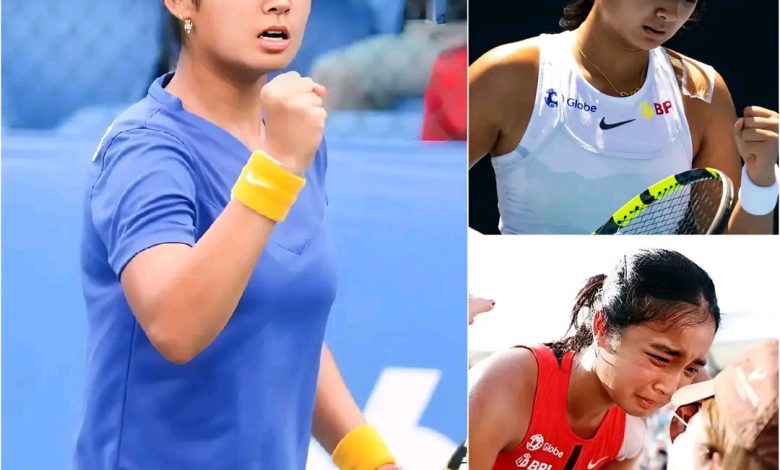
Alex Eala’s voice trembled as those words echoed across social media and press conferences, revealing a young athlete pushed to the emotional brink. The tears she could not hide spoke louder than statistics, rankings, or trophies ever could.
For years, Alex had been celebrated as a symbol of hope for Philippine tennis, a nation hungry for international recognition in the sport. Her victories were shared triumphs, her defeats collective heartbreaks, binding fans and athlete together in rare unity.
That unity fractured painfully when accusations emerged, questioning her motives, loyalty, and integrity. Instead of cheers, she faced suspicion. Instead of encouragement, she encountered harsh judgments from voices she once believed would always stand beside her.
Every match Alex played had been a statement of discipline and sacrifice. Long hours of training, time away from family, and the relentless pressure of competition defined her daily reality. Yet these sacrifices were suddenly reframed as ambition, even selfishness, by critics.
On court, her powerful shots were not merely attempts to win points. They symbolized resistance, a refusal to surrender her principles. Alex believed deeply in clean sport, fairness, and respect, values she carried from childhood into professional competition.
However, this fight began to feel unwinnable. Alex described the situation as a trap, carefully constructed to corner her. Rumors spread faster than facts, and anonymous claims were repeated until they sounded like truth.
“They fabricated baseless accusations just to push me out of the race,” she said, her frustration cutting through carefully measured public statements. To her, the controversy was not about accountability, but about exclusion and control.
The psychological toll was immense. Athletes are trained to endure physical pain, but emotional betrayal leaves different scars. Alex found herself questioning not her abilities, but her belonging, wondering when support had turned into hostility.
Fans debated fiercely online, some defending her passionately, others condemning her without evidence. Each comment added weight to her shoulders. For a young athlete, such scrutiny felt overwhelming, especially when national pride was weaponized against her.
Those closest to Alex described sleepless nights and silent tears. She continued training, but the joy that once fueled her seemed diminished. Tennis, once her sanctuary, now mirrored the conflict she could not escape.
The Philippines has long celebrated athletes as heroes, yet expects them to carry impossible moral burdens. Alex’s case exposed this contradiction, where admiration quickly transforms into disappointment when expectations are no longer perfectly met.
Despite the turmoil, Alex resisted responding with anger. She chose words carefully, emphasizing love for her country and respect for fans. Still, her emotional honesty revealed how deeply the accusations had wounded her spirit.
Shortly afterward, Alex released an official statement. It was calm, measured, and devastating in its sincerity. She spoke of exhaustion, of feeling unheard, and of needing space to protect her mental health and personal dignity.
The reaction was immediate and intense. Many who had doubted her suddenly expressed regret. Messages flooded in, pleading with her to reconsider, to stay, to continue representing the nation that had once lifted her so proudly.
Public opinion shifted, exposing how fragile collective judgment can be. What was condemnation yesterday became remorse today. Alex’s pain forced a reckoning, prompting fans to confront their own role in pushing her toward the edge.
Sports analysts noted how common such scenarios have become, particularly for young athletes in the digital age. Fame arrives early, but emotional resilience takes time to build. Alex’s experience became a cautionary tale.
Her story also sparked broader conversations about athlete welfare in the Philippines. Questions arose about support systems, media responsibility, and the line between accountability and harassment. Alex unintentionally became the face of a larger struggle.
Through it all, she remained composed, refusing to exploit sympathy. Her silence after the statement was powerful, allowing the nation to reflect without her guiding the narrative. Sometimes absence speaks louder than protest.
For many young Filipinos, Alex’s vulnerability made her more relatable than ever. She was no longer just a prodigy or a medal prospect, but a human being grappling with disappointment, loyalty, and heartbreak.
The tennis court will eventually call her back, whether sooner or later. When that moment comes, it will not only test her skill, but the maturity of those watching. Trust, once shaken, must be rebuilt carefully.
Alex Eala’s journey is far from over. Her talent remains undeniable, but her legacy may extend beyond trophies. She has forced a nation to confront how it treats its own heroes when they show pain instead of perfection.
In the end, her plea was simple and devastatingly human. She asked not for blind praise, but for understanding. Having given everything she had, Alex only asked to not be judged as selfish for loving her country her own way.